1.jpg)

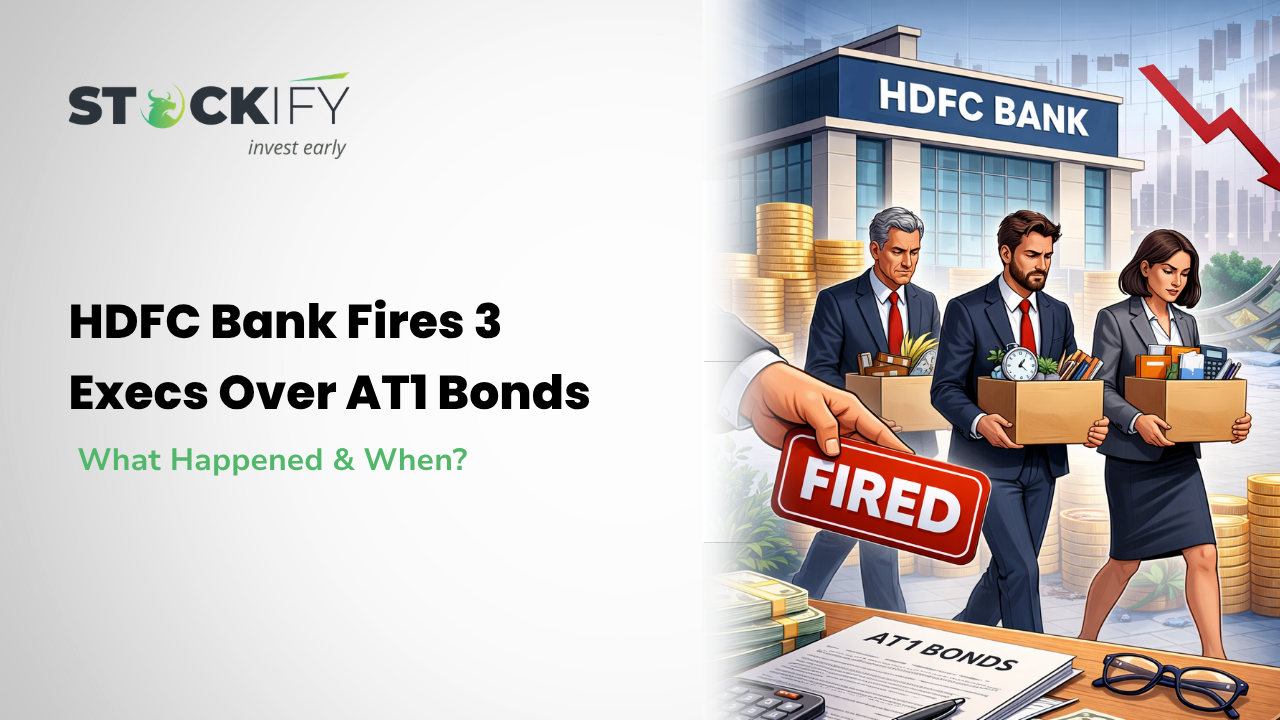
HDFC Bank has terminated three senior executives-Sampath Kumar (Group Head of Branch Banking), Harsh Gupta (EVP), and Payal Mandhyan- following an internal investigation into the mis-selling of high-risk Credit Suisse Additional Tier-1 (AT-1) bonds to NRI clients via its Dubai/Bahrain branches.
The action follows a crack down on onboarding gaps and a sudden resignation of the bank’s chairman.
The Crisis Timeline: What Happened and When
The events unfolded with unusual speed, suggesting the bank’s internal review had already reached its conclusions:
September 2025: The DFSA-Dubai Financial Services Authority has put restrictions on HDFC Bank’s DIFC branch from onboarding new clients, citing compliance concerns.
October 2025: News of an internal investigation surfaces, two executives are placed on administrative leave.
March 17-18, 2026: Part-time Chairman Atanu Chakraborty resigns with immediate effect, citing “certain happenings and practices with the bank that I have observed over the last two years, not in congruence with my personal values and ethics (Source: Rediff)
March 18, 2026: HDFC Bank’s internal review formally concludes.
March 19-21, 2026: Three senior executives were asked to leave; HDFC Bank Share price crashes to a 52 week intraday low of ₹770, closing at ₹800- down 5.1%.
March 19, 2026: The RBI approves former Vice-Chairman HDFC Ltd., Keki Mistry, as interim part-time chairman for 3 months.
Who were the 3 Executives Fired?
CNBC TV-18 was first to report the identities of the three terminated executives:
Sampath Kumar: Group Head, Branch Banking; oversaw branch level distribution including NRI and HNI products.
Harsh Gupta: Executive Vice President, Middle East, Africa &NRI Onshore Business; directly responsible for the Dubai and Bahrain Operations where the alleged mis-selling occurred.
Payal Mandhyan: Senior Vice President; named in the internal probe findings related to client onboarding irregularities.
(Source: Business Today)
All three departures were framed as “resignations accepted by the bank” following the conclusion of the internal review, a common corporate formulation when termination follows a disciplinary process.
Earlier a complaint had been filed with Nagpur Economic Offences Wing (EoW), naming four HDFC Bank Officials in connection with the bonds.
What are AT1 Bonds?
AT1 stands for Additional Tier-1 Bonds. These are debt instruments which are issued by banks in order to add strength to their capital base, complying with Basel III regulations.
Unlike regular bonds, AT1 bonds have no fixed maturity date and carry a bail-in clause-meaning if the issuing bank falls into serious financial distress, these bonds can be written down to zero without any repayment to the bondholder.
This is exactly what happened with Credit Suisse. When the Swiss lender collapsed and was taken over by USB Group AG in March 2023, Credit Suisse’s AT1 bonds worth $20 billion were entirely written off-wiping out the full investment of every bondholder. (Source: Business Today)
This move shocked global financial markets because, in a traditional bankruptcy hierarchy, bondholders are repaid before equity shareholders-but the AT1 bail-in clause reversed this logic entirely.
In a twist that may still benefit affected investors, the Swiss Federal Administrative Court later ruled that the AT1 write-off was “unlawful”. However, UBSs and FINMA (Swiss Regulator) are appealing this ruling before the Swiss Supreme Court, meaning the final resolution is still pending.
AT1 bonds are classified as instruments for sophisticated, institutional or qualified investors only.
How were NRI Clients Allegedly Mis-Sold These Bonds?
This is the core of the scandal!
HDFC Bank’s Dubai International Financial Centre (DIFC) branch and its Bahrain operations were the epicentre of the alleged mis-selling. According to CNBC-TV18’s investigation, bank officials marked these perpetual, high-risk bonds to NRI clients as “fixed maturity, assured return bonds”- the exact opposite of what AT1 bonds are.
One AT1 bondholder gave a chilling firsthand account to CNBC-TV18: “In the Bahrain branch, they convinced us that they are selling fixed maturity assured return bonds. They took my signature on the blank paper” (Source: CNBC TV)
The alleged modus operandi included:
Persuading NRI clients to transfer their FCNR deposits from India to Bahrain and redirect them to AT1 Bonds.
Inflating the income details of NRI clients in official documents to qualify them as "sophisticated investors” eligible to purchase AT1 instruments.
Marketing these bonds as “safe-haven, capital protected investments” to HNI and upper middle class NRI clients who trusted the HDFC bank.
Obtaining client signatures on blank or pre-filled forms, removing the possibility of informed consent.
When Credit Suisse collapsed in March 2023, these clients lost 100% of their invested principal with no recourse-because the bail-in clause is legally watertight.
HDFC Share Price: Impact, Data and Outlook
The market’s reaction was swift and severe. Here is a data snapshot (Source: JM Financial Services)
Date | Price (Close) | Change | Event |
March 18, 2026 | ~₹843 | Pre-crisis baseline | Chakraborty resignation |
March 19, 2026 | ₹800 | –5.1% (intraday low ₹770) | |
March 20, 2026 | ₹786.95 | –1.71% | |
Market Cap Loss | — | ~₹96,000 crore |
The ₹770 intraday level marked a fresh 52 week low, which puts HDFC bank share price in bearish territory.
What Investors Should Know?
Whether RBI issues any formal directive to HDFC bank following the DFSA ban.
The outcome of the Nagpur EoW complaint-if it escalates to an FIR, share price pressure could intensify.
Keki-Mistry’s first 90 days as interim chairman and any structural overhaul he announces.
Progress of the Swiss Supreme Court case on AT1 write off legality-a favorable ruling could partially compensate affected clients, reducing legal liability for HDFC bank.
Conclusion
The HDFC bank AT1 bond scandal is more than a compliance failure-it is a stress test for the governance architecture of India’s most valued private bank. With the chairman gone, three executives fired, a foreign regulator’s ban in place, and a criminal complaint filed, the crisis attacks everything in a reputational emergency.
Let us see what happens next.
Read Stockify for any update on unlisted shares.
FAQs
Why did HDFC bank fire 3 executives?
HDFC bank terminated 3 senior executives following the conclusion of the internal investigation into the alleged misselling of Credit Suisse AT1 Bonds to NRI clients at Dubai and Bahrain.
What are Credit Suisse AT1 Bonds?
Credit Suisse AT1 bonds are perpetual, high-risk instruments that carry a bail-in clause.
How much has the HDFC bank share price fallen due to this crisis?
HDFC bank share price fell over 5.1% on March 19,2026, erasing ₹96,000 crore in market cap across two sessions.