

TL;DR
NSE and BSE are the two largest stock exchanges in India, with rankings of 6th and 7th globally. BSE is older than NSE and has the benchmark index of SENSEX. NSE's benchmark index is NIFTY50.
NSE is bigger than BSE in business, finances, and market share. NSE has reported a profit of Rs 10,302 Cr. in FY26, which is almost 4 times BSE's FY26 profits (Rs 2,334 Cr.). NSE also dominates with more than 75% market share in most equity and derivative trading operations.
If you want to invest in small and emerging companies, BSE is the best option. But if you want to put money long-term in established companies, then NSE would be the best option for you.
..................................................
We come across the word “Stock Exchange” in our day-to-day life, or we may have seen people who work in finance or invest in the stock market. The stock exchange is a crucial component of the stock market, but it does not own stocks. Instead, it is a medium that brings stock sellers and stock buyers to the same platform.
In India, stocks or shares can be traded on different exchanges, such as NSE (National Stock Exchange) or BSE (Bombay Stock Exchange). Stride along with us to learn about the difference between NSE and BSE. Let’s start from scratch.
What Is the National Stock Exchange?
The National Stock Exchange of India Limited is the largest stock exchange in India. Established in 1992 as a refined electronic market, NSE is now a fully automated electronic platform. NSE is the world’s largest derivative exchange by number of contracts and the third largest in cash equities by number of trades. In 1994, stock trading began on the NSE with the introduction of the wholesale debt market and a cash market segment. The exchange was established to bring enhanced transparency to the Indian stock market.
NSE has $4.78 Trillion in total market capitalisation till May 2026 and cemented its name as one of the world’s largest stock exchanges. Currently, the NSE is the 7th largest stock exchange in the world and the 3rd largest in Asia. The main advantages of the NSE are its high liquidity and ease of trading due to its incorporation of the latest technologies.
Currently, NSE conducts transactions in equity and wholesale debt markets. The NIFTY 50 Index is one of the most widely popular offerings of the NSE, which monitors the largest assets in the Indian equity market and represents the majority of total market capitalisation.
What Is the Bombay Stock Exchange?
Incorporated in 1875 as the Native Share and Stock Brokers’ Association, the Bombay Stock Exchange (BSE) is India’s first and largest securities market. One of the largest exchanges in the world, the BSE lists nearly 6000 companies and is known for its support for developing capital markets in India. BSE is the first stock exchange in Asia and encompasses a platform where small and medium enterprises trade equities.
BSE is the first stock exchange in Asia and encompasses a platform where small and medium enterprises trade equities in low volume. BSE had a market capitalisation of over US$5 to $5.5 trillion as of May 26, making it the biggest stock exchange in India. This was a huge achievement for BSE and for the Indian stock market. This can attract more eyes to the equity market of India.
Key Differences Between NSE and BSE
Regardless of whether you're an investor or a trader, you must know what these stock exchanges are and the essential differences between the BSE and the NSE. Here is some useful information about these two stock exchanges that will assist you in recognising and perceiving the distinctions between the NSE and the BSE.
Basis of Comparison | NSE | BSE |
Full Form | National Stock Exchange | Bombay Stock Exchange |
Incorporation | Established in 1992 | Established in 1875 |
Introduction | India’s First Fully Automated, Electronic Trading Platform | The Oldest Stock Exchange In India |
Benchmark Index | NIFTY 50 | SENSEX |
Headquarters | Located In Mumbai | Located In Mumbai |
Companies Listed | 2,720 | 5,647 . |
Products | 1. Equity | 1. Equity |
Market Capitalisation (as of 2026) | Rs 46,506.30 Cr. | Rs 1,69,555 Cr. |
Liquidity | High Liquidity | Low Liquidity |
Global Rank | 7th | 6th |
BSE Vs NSE (Profit & Loss Summary)
FY 25-2026 Particulars (In Rs Cr) | NSE | BSE |
Revenue | 16,601 | 4,470 |
Operating EBITDA | 11,098 | 2,840 |
PBT | 13,896 | 3,087 |
PAT | 10,302 | 2,334 |
EPS | 41.62 | 57.31 |
Balance Sheet: NSE Vs. BSE
Balance sheet as on 31st March 2026 (In Rs. Cr) | NSE | BSE |
Cash And Cash Equivalents | 32,261.15 | 5,173 |
Non-Current Assets | 18,822.61 | 4,556 |
Current Assets | 36,564.57 | 3,717 |
Total Assets | 87,937.44 | 13,446 |
Total Equity | 32,113.54 | 6,673 Cr |
Minority Interest | 122 | |
Non-Current Liabilities | 901.29 | 18.72 |
Current Liabilities | 41,829.17 | 6,773 |
Total Liabilities | 42,744.75 | 6,791.72 |
Total Equity And Liabilities | 87,937.44 | 13,446 |
Difference Between NSE and BSE(Cash Flow Comparison)
Cash Flow Summary (In Rs Crores) | NSE | BSE |
Operating Activity | 23,837 | 2,652 |
Investing Activity | -45.87 | -2,283 |
Financing Activity | -8,808.85 | -316 |
Net Cash Flow | 14,982 | 53 |
Why is the NSE Better Than the BSE?
NSE dominates with more than 75% market share in across most categories.
Compared to BSE, its revenue is 10 times that of BSE for the last four years.
In 2026, NSE's EPS (earnings per share) is Rs 280-300 per share in the financial year 2026, which is 2.3-2.5 times more than the EPS of BSE.
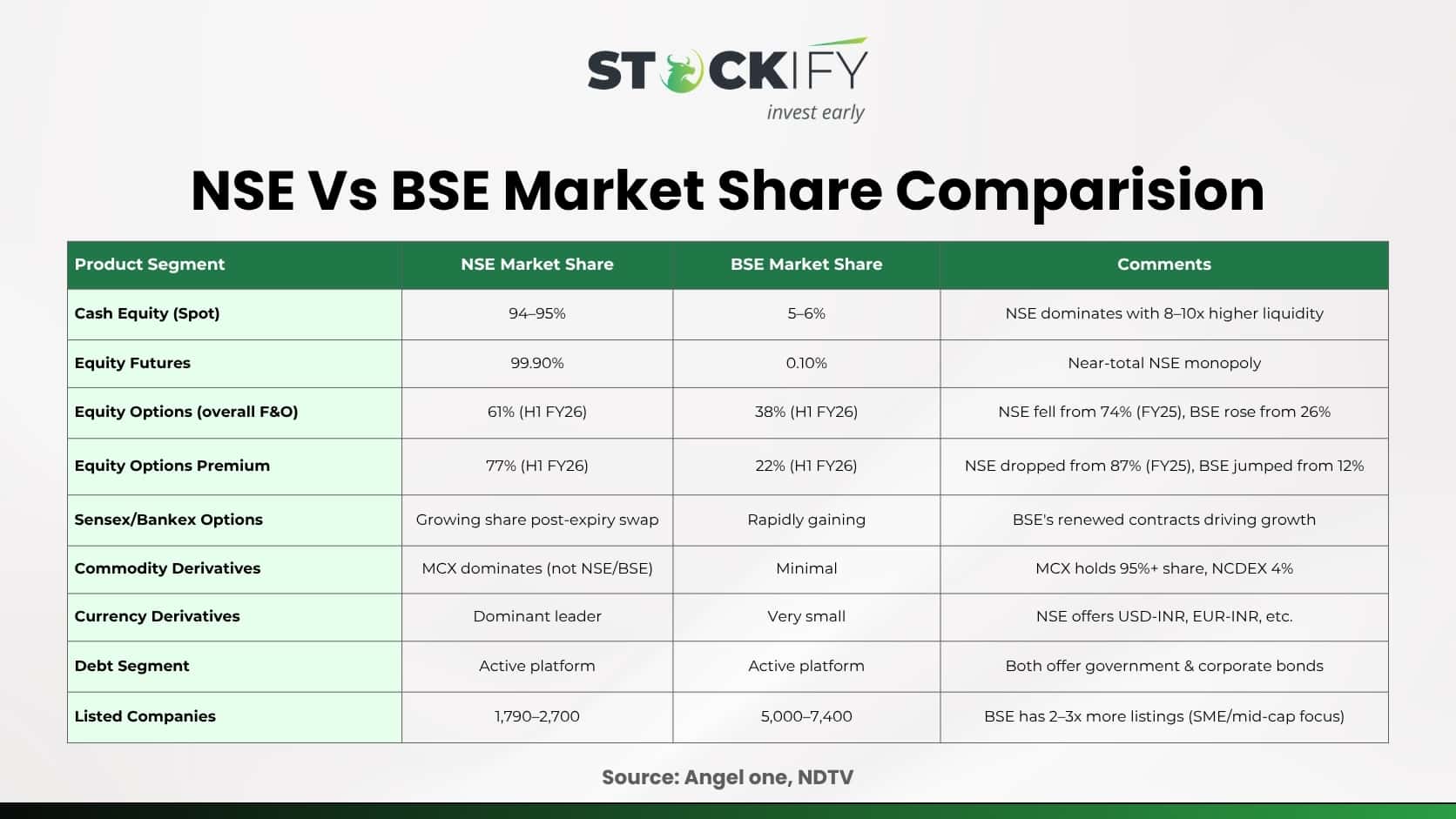
As you can observe, the NSE has a higher trading volume than the BSE, indicating that more buyers and sellers are available for NSE unlisted shares. In addition, NSE’s greater liquidity compared to BSE makes it a better choice. Greater liquidity means easier trading, ultimately providing more opportunities to convert shares into cash.
If you are a retail investor wishing to trade in derivatives, NSE would be a preferred alternative since NSE has a monopoly in the derivative contract segment, and the trading numbers of NSE Nifty are high due to its better liquidity. The current nse share price unlisted is the best bet for you if you wish to put your money into stock investment as a retail investor.
Based on the above data and the comparison, if you buy NSE unlisted shares, count on Stockify. We are one of India’s trusted online stock trading platforms where you can buy and sell unlisted shares in India from the comfort of your home.
Frequently Asked Questions
Who came first, NSE or BSE?
The Bombay Stock Exchange is the first stock exchange in Asia (established in 1975). The National Stock Exchange (NSE) is comparatively newer (established in 1992).
Why Is There a Price Difference Between the NSE And BSE?
The different prices of the same stock at the NSE and BSE will remain because both exchanges are independent in demand, supply and liquidity for the same stock.
Can I buy share on NSE and sell in BSE?
Yes, you can buy shares on NSE and sell in BSE, provided the stock is listed on both exchanges. Interoperability rules will apply.
Should a beginner invest in BSE or NSE?
There is no right exchange for a beginner investing. If you want to invest in small and emerging companies, the BSE is your best option. But if you are a long-term conservative investor, then NSE is a better investment option.