

TL;DR
Vedanta’s demerger received NCLT sanction on December 16, 2025, clearing the way for four independent businesses plus the residual Vedanta Ltd Structure. Vedanta reported Q4 FY 26 revenue of ₹51,524 crore. Post demerger valuation could rise 14% to about ₹650.
Introduction
Vedanta’s demerger is no longer just a boardroom plan; it is now a market-moving event that is directly reshaping how investors read the vedanta share price.
What is the Big NCLT Update?
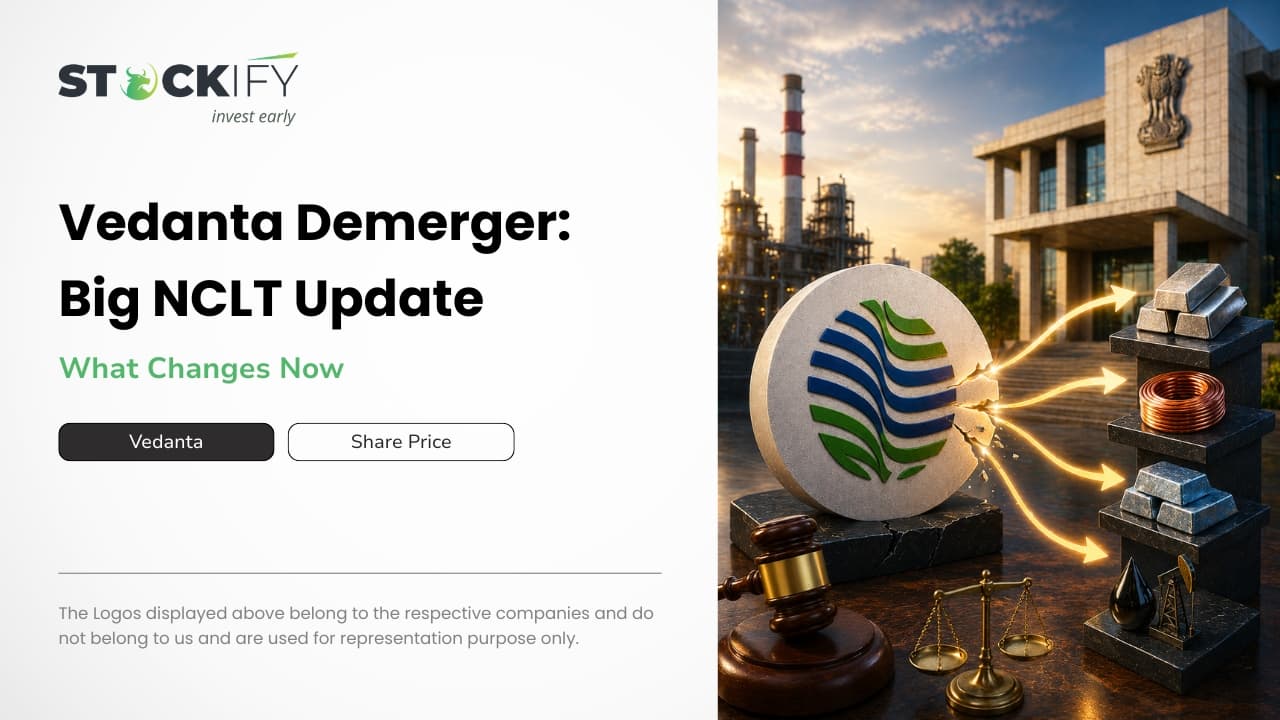
The biggest trigger in this story is that the Mumbai bench of the NCLT sanctioned Vedanta’s demerger scheme on December 16, 2025.
After the approved structure, the group is fast moving towards five separate listed companies in total. It will include Vedanta Ltd and four focused entities to deal in aluminium, oil and gas, iron and steel, and power.
Vedanta has said the reorganisation is designed to unlock long-term value through sharper strategic focus, independent capital allocation, and stronger governance visibility. The group strongly feels that separate entities can attract more suitable investors and direct growth capital because the existing conglomerate format creates a valuation discount and capital-allocation overhang.
Why is Vedanta Share Price Reacting?
For Vedanta, the next major milestone came when Vedanta fixed May 1, 2026 as the record date for the demerger, with the scheme becoming effective on the same day.
Because of the settlement calendar and the market holiday on the record date, the stock turned ex-demerger before that, which changed how traders interpreted the vedanta share price on screens.
The adjustment was visible immediately, with Vedanta opening at ₹325.40 on NSE after turning ex-demerger. The previous close price was ₹327.00. This lower trader price should not be a vacuum, because one listed price is now reflecting only the residual Vedanta business while the rest of the value is expected to sit in the demerged companies. (Source: ET)
Analysts noted that post-demerger the valuation could rise to ₹650 per share, implying 14% upside from pre-adjustment expectations. This does not guarantee gains, but it explains why the market is treating the current Vedanta share price as a transition price rather than a total shareholder value.
Vedanta Share Price
.png)
Source: NSE
Updated FY 26: Key Financials
Some of the key financials include:
Metric | Q4 FY26 Figure | YoY Change |
Revenue from operations | ₹51,524 crore | |
EBITDA | ₹18,447 crore | |
EBITDA margin | ||
PAT (Net profit) | ₹9,352 crore | |
Growth capex (full FY26) | ₹14,918 crore | — |
Net debt/EBITDA | 0.95x |
Source: Business Standard
How Vedanta Demerger Impacts Your Average Costs?
For every one Vedanta share held, eligible shareholders are to receive one share each in the four resulting companies, while continuing to hold their existing Vedanta Ltd Exposure.
It implies that your investment is being split across more listed vehicles, so judging performance only from standalone vedanta share price can lead to the wrong conclusion.
The sharp fall in the parent stock’s quoted price after the ex-demerger date reflects value re-distribution, not necessarily value destruction.
Investors can think at the average cost at the portfolio level after all the resulting shares are credited and begin trading, rather than comparing the old pre-demerger Vedanta price with new residual quote alone.
Let us see an example on how it can affect your average cost: Imagine you bought 100 Vedanta shares at ₹400 average cost, your total investment is equal to ₹40,000. Post demerger, you hold 100 shares each in 5 companies. The average cost will be calculated based on the tax cost allocation, not the ₹400 base.
Why Should Investors Watch Closely?
Vedanta entered this phase after confirming record high revenue, second-highest ever EBITDA, and improved leverage metrics. The company also believes that the shareholders will be able to buy into the exact vertical they prefer, instead of a mixed commodity conglomerate.
Conclusion
Vedanta share price is one part of the story. The NCLT approval has set the demerger in motion, the record date has been fixed. The market is now shifting to valuing one parent company to pricing a basket of focused businesses.
For long-term investors, the concern is not “fall in stock price”, instead it is how much will be the total value combined listed pieces created after the split is fully reflected.
FAQ
What is the latest update on Vedanta demerger?
NCLT on December 16, 2025 cleared the major hurdle for restructuring.The company then moved to execution phase from 1 May, 2026.
How many shareholders receive after the demerger?
Each shareholder will receive one share in each four resulting companies.
Why was there a fall in vedanta share price?
Vedanta opened at ₹325.40 on the NSE after the ex-demerger adjustment.
Does the lower Vedanta share price mean investors have lost money?
Not necessarily. Shareholders are being allocated exposure to multiple businesses under the approved scheme.