



Table of Contents
Buy/Sell Your Unlisted Shares
Submit the details below to share a quote.
As Union Budget 2026 week begins, the market’s already reacting. The Nifty has slipped nearly 5% in just 11 trading sessions and broken below its long-term 200-day moving average, a level many investors quietly track even if they don’t trade on charts every day.
With Finance Minister Nirmala Sitharaman set to present the Budget 2026 on February 1, markets are open even though it falls on a Sunday. That alone tells you how closely this event’s being watched.
What’s Happening As Nifty Crashes?
The recent fall of 5% in Nifty didn’t happen suddenly. Selling has been spread across the market, with large companies pulling the index down and mid and small-cap stocks falling even more.
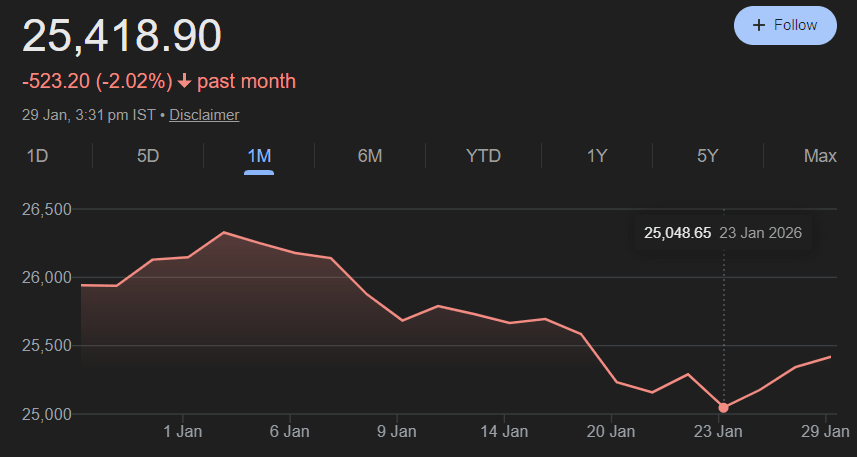
The index has moved below its 200-day average, which usually signals caution rather than panic. Simply, investors are being careful, not fearful.
What’s noticeable is that the market hasn’t recovered much, even after a small bounce back. That often means investors aren’t rushing to buy every dip. Instead, many seem to be waiting for clarity, especially around income tax relief, capital gains changes and how different sectors might be treated in Budget 2026.
While looking back, Budget Day itself might not have caused big market swings in recent years. Sharp rallies or crashes on the day of the Budget have become less common. Maybe some positioning tends to happen in advance before the Budget. That same pattern looks to be playing out again this year.
How Budget 2026 Could Impact the Indian Stock Market?
Budget announcements still matter, but the way markets react has changed.
Instead of a sharp move on Budget Day, markets now take time.
Investors usually go through the numbers slowly, look beyond headlines and try to understand how policies might affect company earnings over time, instead of a small spike.
Previous budgets leaned more toward supporting consumption through tax relief and spending measures. This time, attention seems to be moving toward production and long-term growth, with capital expenditure playing a bigger role.
Key areas markets tend to scan quietly:
Fiscal discipline and deficit targets
Capital expenditure direction, especially infrastructure and defence
Shows on tax stability, not just tax cuts
Government intent on growth versus consolidation
What’s different this time is that market moves may not be even across sectors. Stocks within the same sector could react differently, with companies showing stronger execution, healthier balance sheets and clearer earnings standing out more.
Impact on different Sectors of Budget 2026
Focus areas are likely to include:
Indigenisation, encouraging companies to add more value within India
Infrastructure development to improve transport, logistics and connectivity
Income creation through stable and productive employment.
Support for MSMEs and exporters, along with an expansion of the production-linked incentive (PLI) scheme, could also shape sector-level outcomes.
Sectors aligned with these priorities, such as roads, railways, defence manufacturing, logistics, and renewable energy, are expected to remain in focus.
Defence spending, in particular, could see continued support, while emerging areas like semiconductors, data centres and critical minerals supply chains are also being closely watched.
At the same time, agriculture and rural stability continue to play an important role in supporting the broader economy.
For the banking and financial sector, fiscal discipline remains a key signal.
According To Business Standard,Nomura believes the government will place greater emphasis on managing debt in FY27, which could influence bond yields and funding costs. For banks and financial institutions, this makes asset quality and risk management even more important.
The brokerage estimates government debt could be set at around 55% of GDP in FY27, slightly lower than last year and aligned with a fiscal deficit of about 4.2% of GDP.
Why Budget Day Volatility Feels Different Now?
Today, policymaking happens throughout the year, with reforms coming through GST Council decisions, cabinet announcements and regular regulatory updates.
Because of this, Budget Day still sees some volatility, but it might often feel like an extension of existing trends rather than a new turning point. Markets can now react less to surprises and more to whether policies stay consistent over time.
What Investors Are Really Watching?
Instead of reacting to headlines, investors are paying attention to a few key signals:
Whether there’s clarity or stability around capital gains and securities taxes
How the government balances growth-focused spending with fiscal discipline
Whether the long-term policy direction remains predictable
Retail investors, who now hold a larger share of the market, tend to be especially sensitive to tax uncertainty. Even small policy signals can influence sentiment more than expected.
Overall, Budget 2026 comes at a time when Nifty is already under pressure and market sentiment is cautious. Any recovery or further decline will depend less on one announcement and more on how the budget signals match expectations already priced in.
You may also like to read

What Are The Different Classes Of Shares Issued In India?

Different Classes of Assets In The Financial Market

Follow These Simple Share Market Tips While Investing

Importance of Investing in Unlisted Shares

Step-by-step Process Of Transferring Unlisted Shares (Off-market)

Pre IPO Success Stories To Start Your Unlisted Share Trading

What Is The Expected Return Of Unlisted Shares?

A Detailed Guide On How To Buy Unlisted Shares In India

Know Your Tax Implications Before Investing In Unlisted Shares

Common Mistakes To Avoid While Investing In Unlisted Shares

How To Pick Best Performing Unlisted Stocks in India?

Risks And Rewards Associated With Unlisted Share Investment

Difference Between Start-Up Investing And Unlisted Shares?

IPO Process in India: Key Steps Explained Clearly

Revealed: The Real Picture of Unlisted Shares in Grey Market

Key Financial Ratios And How To Use Them To Analyse Your Investment

101 Guide For Beginners: What Is Pre IPO Share Market?

10 Golden Rules Of Investing In Stock Market

Listed Shares Vs. Unlisted Shares - Detailed Comparison

The Dark Side of Paytm's IPO Explained In Details

What Leads to Delisting of Shares and What Goes Behind The Scenes?

When Should You Review Your Portfolio Professionally?

In-Depth Analysis of Pre-IPO Shares for Portfolio Growth

PharmEasy Unlisted Price Falls 70%. Here's why

Delaying Pre-IPO Investments? Here’s What You Risk

An NRI’s Guide To Invest In Unlisted Shares In India

Guide To Filter The Most Profitable Unlisted Companies In India

A Comprehensive Guide On Follow-on Stocks

Care Health Insurance

Smart Strategy to Buy & Sell Unlisted Shares Professionally

Top Highly Profitable Unlisted Companies In India To Look For As An Investor

Upcoming IPOs In 2022-2023

Expert’s Driven Roadmap To Research A Startup IPO

Capgemini Unlisted Shares: Is The Risk Worth?

HDFC Sec vs HDB Financial: Which Is the Better Pick?

Detailed Guide To Calculate Capital Gains on Unlisted Shares

Dematerialisation of Unlisted Shares and Its Impact On Shareholders

How are B9 Beverages Pvt Ltd (Bira91) Unlisted Shares Gaining Pace Again?

Reliance Retail: The Success Story of India's Largest Retail Brand

The Future Of Unlisted Shares In the Fintech Market
Employee Stock Ownership Plan: What, How, and Why?

Studds Unlisted Shares: 6 Reasons to Buy Now

LAVA’s Unlisted Shares Soar Under Atmanirbhar Push

NSE vs BSE: Detailed 101 Market Share Comparison

The Role Of Corporate Governance And Management In Unlisted Companies

What's Temperature Ahead Of Tata Technologies' ₹4,000 Cr. IPO?

The Future Outlook For Unlisted Shares As An Investment Option

How to Buy and Sell Unlisted Shares in India?

The Benefits And Drawbacks Of Investing In Unlisted Shares