



Table of Contents
Buy/Sell Your Unlisted Shares
Submit the details below to share a quote.
If you track India’s unlisted shares market, you must have noticed one name trending sharply in recent weeks: Metropolitan Stock Exchange of India (MSEI). After years of almost no activity, MSEI is trying to make a comeback. The MSEI unlisted shares have almost jumped 110% within a week. This doesn't happen overnight. And in MSEI’s case, it is a trading restart plan, SEBI approvals and a liquidity push.
Let’s break it down.
MSEI Coming Up Vs BSE And NSE
MSEI is trying to position itself as a serious contender to become India’s 3rd major stock exchange, after NSE and BSE. The exchange has remained relatively inactive for years, but fresh regulatory updates and business plans are now creating momentum. MSE plans to begin operations with trading in around 130 stocks.
This structure mirrors earlier attempts made by the exchange in its previous avatar. The difference this time is the scale of preparation and capital support behind the relaunch. The exchange is aiming to avoid direct competition on peak trading days and instead focus on building steady participation over time.
Read More: MSEI Set To Compete BSE, NSE In Trading
Trading Restart by the end of Jan 2026
One of the biggest headlines around MSEI is that the exchange is working towards restarting stock trading operations, reportedly beginning with trading in nearly 130 stocks. This development matters because it immediately changes the perception of MSEI in the market.
For years, the exchange has remained relatively inactive, so a confirmed restart is being seen as a comeback.
From a business point of view, this is clearly positive for MSEI because an exchange only becomes meaningful when trading activity exists. Revenue streams such as transaction charges, listing-related income, membership fees and data/technology services can only scale when trading resumes.
Even if the initial volumes are limited, the restart shifts MSEI’s identity from an inactive to an operational exchange, which is exactly what investors are pricing in.
SEBI Approved Liquidity Enhancement Scheme (LES)
Along with the relaunch narrative, SEBI’s approval for MSEI’s Liquidity Enhancement Scheme (LES) has become a major confidence booster.
Under LES, designated market makers are expected to provide 2-way quotes, both buy and sell orders, so that volumes build consistently and trading does not look thin during the early days.
This is important because exchanges are not built on branding or announcements.
They survive on liquidity. If traders do not see tight bid/ask spreads, quick execution and a strong order book, they simply won’t participate. That is why LES acts like a growth engine for MSEI.
It improves daily trading activity, reduces the risk of the exchange looking inactive and makes participation smoother for brokers and investors.
Rs.1,240 Crore Funding
Another major reason the market is taking MSEI more seriously this time is the funding support. Reports suggest that MSEI has raised around Rs. 1,240 crore across multiple rounds, and this capital infusion changes the strength of the relaunch.
Exchange businesses require strong technology infrastructure, surveillance and risk control systems and strict compliance frameworks, especially under SEBI guidelines. Additionally, liquidity incentives themselves need working capital. This funding means MSEI is not restarting cheaply or casually. It has the financial capacity to upgrade systems, meet regulatory requirements and support liquidity-building efforts under LES.
In investor terms, this gives MSEI runway, time and resources to operate and build momentum without depending immediately on massive trading volumes.
SEBI’s Broader Governance Push
SEBI has initiated reviews like LODR (Listing Obligations and Disclosure Requirements), and institutions such as NSE and BSE are also strengthening senior leadership teams in areas like compliance, risk management and investor grievance systems. This matters because its biggest challenge is not just relaunching trading, but rebuilding credibility. When regulatory expectations rise across the ecosystem, exchanges are judged on governance standards, surveillance capability, transparency and operational stability.
For MSEI, this becomes both an opportunity and a pressure point. If the exchange builds strong systems and governance, it can position itself as a serious market institution. But if it falls short, the market will quickly lose confidence.
However, the NSE and BSE already dominate liquidity and shifting traders away from established platforms is complicated.
MSEI Share Price Jumps 2X In 1 Week
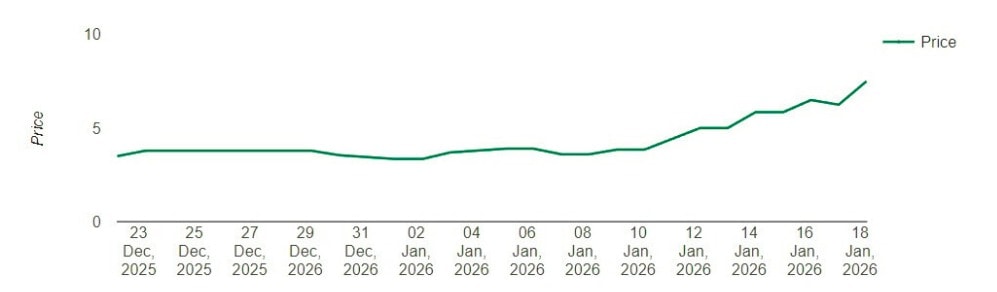
The MSEI share price action has been hard to ignore. In just one week, the share price jumped from Rs. 3.85 on 10 January to Rs. 7.5 on 19 January, almost a 2x. And within a month, it almost doubled, from Rs. 3.5 on 22 December to Rs. 7.5 by 19 January. When an unlisted share rises this fast, it usually means the market has picked up strongly.
The current jump is mainly built on 3 pillars:
MSEI may restart trading operations by the end of Jan 2026
SEBI approved Liquidity Enhancement Scheme (LES)
Massive capital raised and utilised (Rs.1,240 crore), giving it financial strength
Together, these signals are making investors believe that MSEI could finally attempt a comeback. That is why the real question isn’t whether MSEI will restart, it is whether MSEI can sustain liquidity after the initial excitement fades. If it succeeds, this could become one of India’s most interesting market infrastructure turnaround stories. But if trading volumes remain weak, the MSEI Share Price rally may stay largely sentiment-driven rather than business-driven.
You may also like to read

What Are The Different Classes Of Shares Issued In India?

Different Classes of Assets In The Financial Market

Follow These Simple Share Market Tips While Investing

Importance of Investing in Unlisted Shares

Pre IPO Success Stories To Start Your Unlisted Share Trading

Step-by-step Process Of Transferring Unlisted Shares (Off-market)

What Is The Expected Return Of Unlisted Shares?

Common Mistakes To Avoid While Investing In Unlisted Shares

Know Your Tax Implications Before Investing In Unlisted Shares

How To Pick Best Performing Unlisted Stocks in India?

Risks And Rewards Associated With Unlisted Share Investment

A Detailed Guide On How To Buy Unlisted Shares In India

Difference Between Start-Up Investing And Unlisted Shares?

IPO Process in India: Key Steps Explained Clearly

Revealed: The Real Picture of Unlisted Shares in Grey Market

Key Financial Ratios And How To Use Them To Analyse Your Investment

10 Golden Rules Of Investing In Stock Market

101 Guide For Beginners: What Is Pre IPO Share Market?

Listed Shares Vs. Unlisted Shares - Detailed Comparison

The Dark Side of Paytm's IPO Explained In Details

What Leads to Delisting of Shares and What Goes Behind The Scenes?

When Should You Review Your Portfolio Professionally?

In-Depth Analysis of Pre-IPO Shares for Portfolio Growth

PharmEasy Unlisted Price Falls 70%. Here's why
Delaying Pre-IPO Investments? Here’s What You Risk

An NRI’s Guide To Invest In Unlisted Shares In India

Guide To Filter The Most Profitable Unlisted Companies In India

A Comprehensive Guide On Follow-on Stocks

Smart Strategy to Buy & Sell Unlisted Shares Professionally

Care Health Insurance

Top Highly Profitable Unlisted Companies In India To Look For As An Investor

Upcoming IPOs In 2022-2023

Capgemini Unlisted Shares: Is The Risk Worth?

Expert’s Driven Roadmap To Research A Startup IPO

HDFC Sec vs HDB Financial: Which Is the Better Pick?

Detailed Guide To Calculate Capital Gains on Unlisted Shares

Dematerialisation of Unlisted Shares and Its Impact On Shareholders

How are B9 Beverages Pvt Ltd (Bira91) Unlisted Shares Gaining Pace Again?

Reliance Retail: The Success Story of India's Largest Retail Brand

The Future Of Unlisted Shares In the Fintech Market
Employee Stock Ownership Plan: What, How, and Why?

Studds Unlisted Shares: 6 Reasons to Buy Now

LAVA’s Unlisted Shares Soar Under Atmanirbhar Push
NSE vs BSE: Detailed 101 Market Share Comparison

The Role Of Corporate Governance And Management In Unlisted Companies

The Future Outlook For Unlisted Shares As An Investment Option

How to Buy and Sell Unlisted Shares in India?

The Benefits And Drawbacks Of Investing In Unlisted Shares

What's Temperature Ahead Of Tata Technologies' ₹4,000 Cr. IPO?