

1.jpg)
Table of Contents
Buy/Sell Your Unlisted Shares
Submit the details below to share a quote.
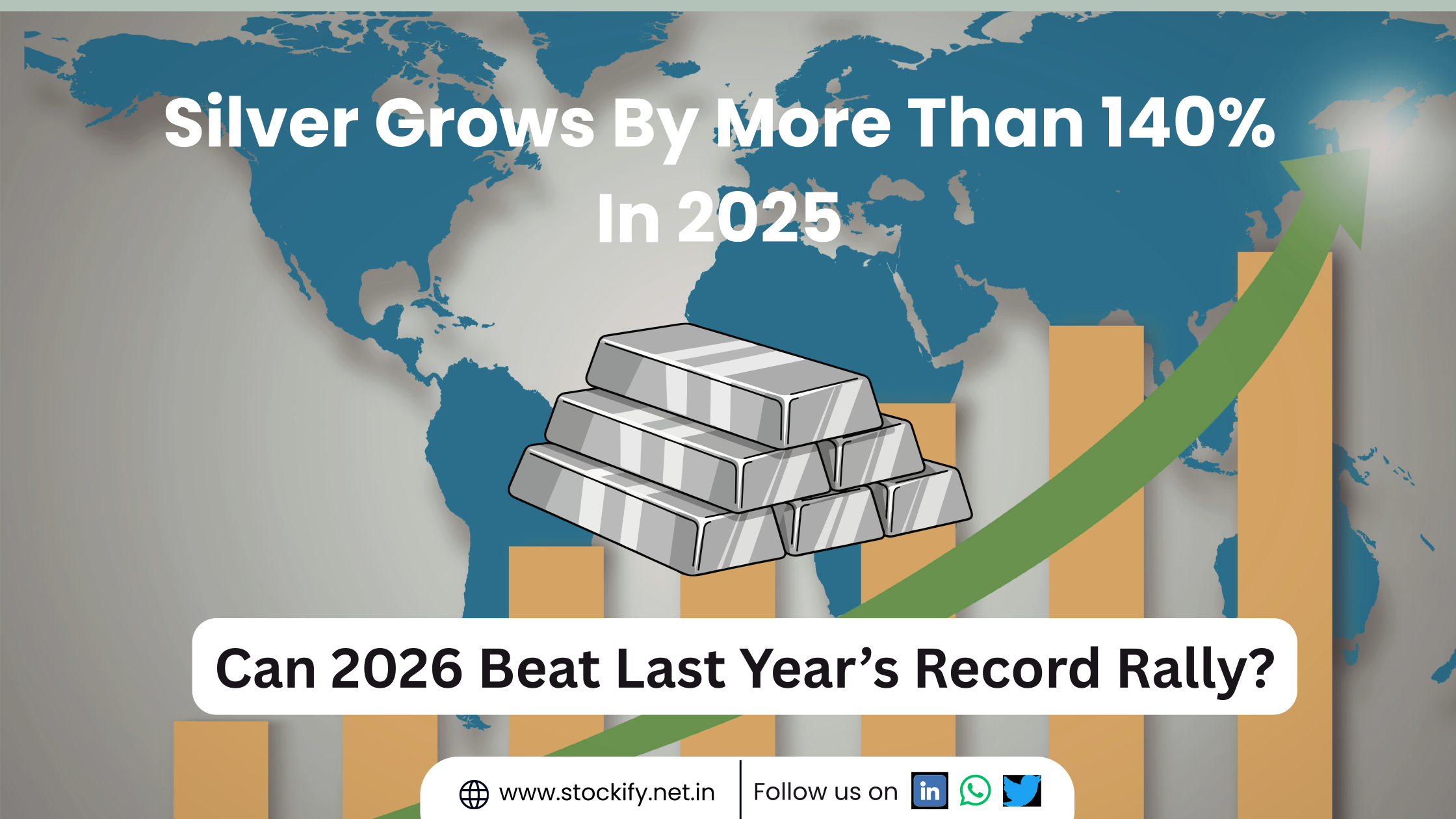
The silver market has entered territory that few investors expected even two years ago. What began as a steady recovery after the pandemic years transformed into one of the most powerful commodity rallies in modern financial history. By the end of 2025, silver was no longer viewed merely as a volatile cousin of gold. It had emerged as a strategic asset, balancing its role as a precious metal with its growing importance in industrial and energy-transition applications.
As 2026 unfolds, a crucial question dominates investor conversations: can silver beat its 2025 record highs, and if it does, what happens next? The answer is nuanced. While evidence strongly suggests that 2026 will exceed 2025 in absolute price terms, the path forward is likely to be far more volatile and selective than the euphoric surge witnessed last year.
This blog breaks down what truly drove silver’s historic rise, where prices stand today, what analysts expect in 2026, and how Indian investors should think about silver going forward.
Silver in 2025: A Year That Changed the Narrative
Silver’s performance in 2025 rewrote decades of market assumptions. The metal delivered returns in the range of 147% to 170 %, outperforming gold, equities, and most commodities. More importantly, it broke a psychological and historical barrier by crossing price levels last seen during the Hunt brothers episode of 1980.
Internationally, silver surged from roughly Rs. 2.49 lakh per kilogram at the start of 2025 to peaks well above Rs. 43.85 lakh per kilogram by October, before accelerating further toward the end of the year. By mid-January 2026, international prices were trading close to Rs. 76 lakh per kilogram.
In India, the rally was just as dramatic. MCX silver climbed from around Rs. 90,000 per kilogram in early 2025 to nearly Rs. 2,50,000 by December. By January 18, 2026, prices touched Rs. 2,95,000 per kilogram, marking nearly 24 % gains in just the first few weeks of the year.
Snapshot of silver performance
Metric | Early 2025 | End 2025 | Jan 2026 |
International price (Rs. /kg) | ~2.49 lakh | ~43.85 lakh | ~76 lakh |
MCX Silver (Rs. /kg) | ~90,000 | ~2.50 lakh | ~2.95 lakh |
Annual return (2025) | - | 147-170% | - |
Gold return (2025) | - | ~76% | - |
Silver also compressed the gold-to-silver ratio to nearly 50:1, a 13-year low. Historically, such compression signals either an overheated silver market or a structural repricing. In 2025, evidence leaned strongly toward the latter.
Why Silver Rallied So Hard
Unlike previous silver spikes driven largely by speculation, the 2025 rally was rooted in multiple overlapping fundamentals.
A)Structural Supply Deficits
Silver entered its fifth consecutive year of supply deficit. Global production hovered around 1.03 billion ounces annually, while demand crossed 1.2 billion ounces. The gap was too large to ignore.
What makes silver unique is that nearly 70 % of the global supply is produced as a by-product of copper, lead, and zinc mining. Even at record silver prices, miners cannot quickly increase output unless base metal production rises. This structural rigidity meant higher prices did not translate into higher supply.
Exchange inventories reflected this tightness. Stocks at major exchanges such as LBMA and Shanghai declined sharply, and periods of backwardation appeared, a rare signal of immediate physical shortage.
B)Industrial Demand Took Centre Stage
Silver is no longer driven primarily by jewellery or investment. Industrial usage now accounts for nearly 59 % of global demand, up from around 45 % a decade ago.
Solar energy remains the single largest driver. Silver’s unmatched electrical conductivity makes it essential in photovoltaic cells. Electric vehicles added another layer of demand, using three to five times more silver than internal combustion vehicles due to advanced electronics, sensors, and battery systems.
A newer but fast-growing contributor is AI infrastructure. Data centres, high-performance chips, and thermal management systems require reliable, high-conductivity materials. Silver fits that role.
In a significant policy shift, the United States added silver to its Critical Minerals List in 2025, formally recognising its strategic importance.
C)India’s Outsized Role
India became a central pillar of the global silver rally. The country imported nearly 6,000 metric tons of silver in 2025, around a quarter of global supply. Unlike past cycles, demand rose even as prices climbed.
This shift was driven by investment demand, especially through silver ETFs. Since their launch in 2022, Indian silver ETFs have grown rapidly, accounting for over 40 % of physical investment demand by 2024. At peak in September 2025, monthly ETF inflows exceeded Rs. 5,300 crore.
Silver was no longer just a decorative metal in India. It became a financial asset.
D)Macro and Geopolitical Tailwinds
Geopolitical tensions across multiple regions, combined with US Federal Reserve rate cuts and a weakening dollar, boosted demand for real assets. Silver benefited from this environment while also enjoying industrial demand, a combination that gold does not fully share.
Can 2026 Beat 2025’s Record High?
In nominal terms, the answer is already yes. Silver crossed the 2025 peak within weeks of entering 2026. The more meaningful question is whether prices can hold and build above those levels.
Most evidence suggests:
H1 2026 is likely to remain strong, supported by industrial demand, currency weakness, and lingering geopolitical uncertainty.
H2 2026 carries a higher risk, as profit-taking, demand normalisation, and policy shifts could introduce sharp corrections.
Possible 2026 Scenarios
Scenario | Price Range (Rs. /kg) |
Conservative | 48-58 lakh |
Base case | 62-70 lakh |
Buillish | 75-83+ lakh |
Bearish | 50-54 lakh |
Even in conservative scenarios, prices remain above the 2025 record high, reinforcing the idea that silver has shifted to a higher long-term range.
India-Specific Factors That Matter in 2026
India’s silver market has dynamics distinct from global trends.
Rupee Depreciation as a Multiplier
A weakening rupee amplifies global silver gains for Indian investors. If the USD-INR moves toward the 90–95 range, even stable international prices could translate into higher domestic prices.
Regulatory Support
From April 2026, banks in India will be allowed to lend against silver jewellery, placing silver closer to gold in terms of financial utility. This change alone could unlock demand from households holding thousands of tonnes of silver.
Seasonal and Cultural Demand
Wedding and festival seasons still matter. While high prices may suppress volume temporarily, they also reinforce silver’s perception as a store of value rather than a consumption good.
Risks Investors Should Not Ignore
Despite strong fundamentals, silver remains volatile.
A global recession could hurt industrial demand.
A sudden rise in real interest rates could pressure precious metals.
Recycling and scrap supply could increase if prices stay elevated.
Retail participation via ETFs could reverse quickly if sentiment shifts.
History shows that silver rallies often include 20 to 40 % corrections, even within long-term bull markets.
What Comes Next: A Different Phase of the Cycle
Silver’s journey from 2020 to 2025 was about recognition. The next phase is about consolidation and validation.
Rather than expecting another 150 % rally, investors should expect:
Wider price swings
Periods of consolidation
Strong long-term support driven by industrial demand
According to Motilal Oswal Financial Services, silver is now part of a broader commodity supercycle linked to renewable energy, electrification, and currency debasement. In this framework, corrections are not trend breaks but structural resets.
Conclusion: New Highs, But With Discipline
Silver’s 2025 rally was not an accident. It was the result of years of underinvestment, rising industrial dependence, and changing investor behaviour. In 2026, silver is very likely to trade above its 2025 record highs, but the journey will be uneven.
For investors, the opportunity remains, but so does the risk. Silver is no longer a speculative side bet. It is a strategic asset that demands patience, risk management, and realistic expectations.
You may also like to read
What Are The Different Classes Of Shares Issued In India?
Different Classes of Assets In The Financial Market

Follow These Simple Share Market Tips While Investing
Importance of Investing in Unlisted Shares

Step-by-step Process Of Transferring Unlisted Shares (Off-market)

Pre IPO Success Stories To Start Your Unlisted Share Trading

What Is The Expected Return Of Unlisted Shares?

A Detailed Guide On How To Buy Unlisted Shares In India

Know Your Tax Implications Before Investing In Unlisted Shares
Common Mistakes To Avoid While Investing In Unlisted Shares
How To Pick Best Performing Unlisted Stocks in India?
Risks And Rewards Associated With Unlisted Share Investment
Difference Between Start-Up Investing And Unlisted Shares?
IPO Process in India: Key Steps Explained Clearly
Revealed: The Real Picture of Unlisted Shares in Grey Market
Key Financial Ratios And How To Use Them To Analyse Your Investment

101 Guide For Beginners: What Is Pre IPO Share Market?

10 Golden Rules Of Investing In Stock Market
Listed Shares Vs. Unlisted Shares - Detailed Comparison

The Dark Side of Paytm's IPO Explained In Details

What Leads to Delisting of Shares and What Goes Behind The Scenes?
When Should You Review Your Portfolio Professionally?

In-Depth Analysis of Pre-IPO Shares for Portfolio Growth
PharmEasy Unlisted Price Falls 70%. Here's why
Delaying Pre-IPO Investments? Here’s What You Risk

An NRI’s Guide To Invest In Unlisted Shares In India
Guide To Filter The Most Profitable Unlisted Companies In India
A Comprehensive Guide On Follow-on Stocks

Care Health Insurance

Smart Strategy to Buy & Sell Unlisted Shares Professionally
Top Highly Profitable Unlisted Companies In India To Look For As An Investor

Upcoming IPOs In 2022-2023
Expert’s Driven Roadmap To Research A Startup IPO
Capgemini Unlisted Shares: Is The Risk Worth?

HDFC Sec vs HDB Financial: Which Is the Better Pick?

Detailed Guide To Calculate Capital Gains on Unlisted Shares
Dematerialisation of Unlisted Shares and Its Impact On Shareholders

How are B9 Beverages Pvt Ltd (Bira91) Unlisted Shares Gaining Pace Again?

Reliance Retail: The Success Story of India's Largest Retail Brand
The Future Of Unlisted Shares In the Fintech Market
Employee Stock Ownership Plan: What, How, and Why?

Studds Unlisted Shares: 6 Reasons to Buy Now

LAVA’s Unlisted Shares Soar Under Atmanirbhar Push
NSE vs BSE: Detailed 101 Market Share Comparison

The Role Of Corporate Governance And Management In Unlisted Companies
What's Temperature Ahead Of Tata Technologies' ₹4,000 Cr. IPO?
The Future Outlook For Unlisted Shares As An Investment Option

How to Buy and Sell Unlisted Shares in India?

The Benefits And Drawbacks Of Investing In Unlisted Shares