

1.jpg)
Table of Contents
Buy/Sell Your Unlisted Shares
Submit the details below to share a quote.
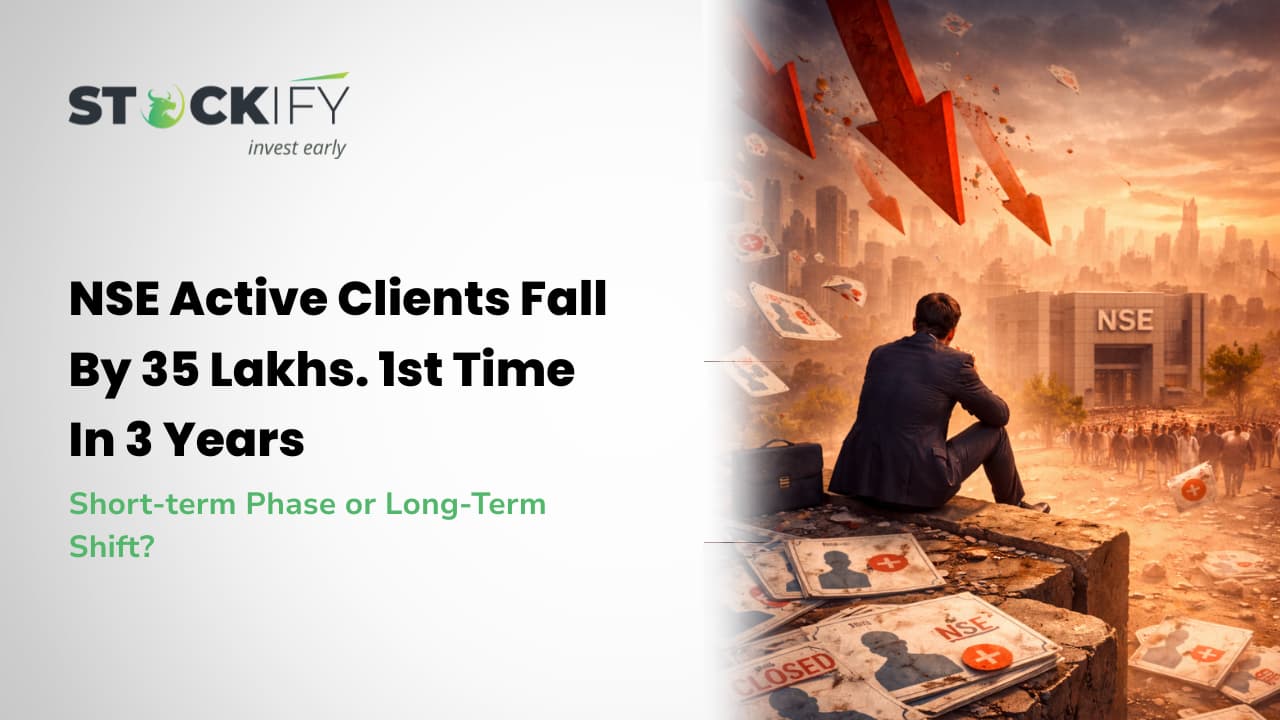
Millions of new investors entered the stock market, driving record growth in the NSE investor base and fostering a trading boom across platforms. But FY26 tells a slightly different side. For the first time in three years, the NSE investor base has declined by 7%, with nearly 35 lakh active investors having decreased. So, what changed? Is this decline just a temporary pause, or are retail investors becoming more cautious after years of aggressive participation? Let's discuss in detail.
NSE Investor Base Declines by 7% in FY26
Broker | FY25 | FY26 | Change% |
Groww | 26.26% | 28.31% | 2.04 |
Zerodha | 16.03% | 15.08% | -0.95 |
Angel One | 15.40% | 14.79% | -0.61 |
Upstox | 5.58% | 4.35% | -1.24 |
ICICI Sec | 3.96% | 4.57% | 0.61 |
Kotak Sec | 3.02% | 3.03% | 0.01 |
HDFC Sec | 3.10% | 3.04% | -0.06 |
Motilal Oswal | 2.06% | 1.97% | -0.09 |
SBI Caps | 1.99% | 2.55% | 0.55 |
Dhan | 1.98% | 2.27% | 0.29 |
In FY26, the NSE investor base saw a noticeable decline, with active clients falling 7% YoY to around Rs. 4.57 crore, down from Rs. 4.92 crore in FY25. This means a drop of nearly 35 lakh active accounts, likely making it the first annual contraction in the NSE investor base in the past three years. After a strong period of rapid growth, this slowdown highlights a shift in retail investors' behaviours. Reduced activity among retail traders largely drove the decline in the NSE investor base.
Top Trading Platforms Lose Millions as Retail Activity Slips
As retail participation slowed in FY26, the impact was most likely visible on India’s top trading broking platforms. Brokers such as Zerodha, Angel One, and Upstox experienced a sharp decline in active users in FY26 compared to FY25 and can be considered as follows:
Zerodha lost around 9.95 lakh accounts, contributing nearly 29% of the total decline
Angel One saw a drop of 8.15 lakh accounts, nearly 23%
Upstox declined by 7.6 lakh accounts, around 22%
While together, all 3 platforms accounted for over 70% of the total drop in NSE active clients. This decline could likely be due to the market conditions becoming tougher, which might be less rewarding. Many of these users either reduced their activity or might have exited altogether, which could directly impact the user base of these platforms.
Groww Surges While Traditional Brokers Gain Trust
Even as most platforms struggled with declining activity, Groww moved in the opposite direction, continuing to add users and increase its market share from 26.26% to 28.31% in FY26. This increase is likely due to Groww’s performance, which indicates a shift in user preference toward platforms offering simplified investing experiences and strong onboarding funnels.
At the same time, traditional brokers are quietly gaining ground. Firms like ICICI Securities (growing from 3.96% to 4.57% in FY26) and SBI Securities (growing from 1.99% to 2.55% in FY26) experienced steady growth, while players like Dhan and Paytm Money also added users. This could likely suggest that in a more uncertain and volatile market environment, some investors may be prioritising trust, research support, and stability over low-cost trading
Possible Reason For The Slowing Down Of Retail Trading?
1. Market Volatility & Weak Returns
FY26 turned out to likely be a challenging year for equity investors. Benchmark indices like the Nifty 50 ended the year slightly negative, and broader markets delivered muted returns. Sharp corrections, including an 11% monthly fall at one point, might have made retail traders more cautious, especially those who entered during the bull run phase. Hence, such events could have reduced the participation.
2. Heavy Losses in F&O Segment
One of the biggest hidden reasons is likely the derivatives trading losses. Retail investor losses in the F&O segment jumped 41% to Rs. 1.06 lakh crore in FY25. This triggered tighter regulation by SEBI. SEBI responded by increasing lot sizes, reducing expiry options, and tightening speculative trading.
3. Global & Macro Pressures
Global factors might have also played a crucial role in weakening sentiment. Rising crude oil prices crossing $100 per barrel, along with geopolitical tensions like the US-Iran-Israel conflict, created uncertainty in global markets. Also, foreign investors might pull out billions from the Indian market. Hence, retail investors might become cautious as markets turn unpredictable and globally sensitive
4. Continuous FII Selling
Foreign Institutional Investors (FIIs) remained net sellers for a large part of FY26, with around $18 billion in sell-offs seen during volatile phases. Despite strong domestic inflows, this persistent selling pressure kept markets under stress, reducing confidence among retail investors. Even strong domestic inflows likely couldn’t fully offset sentiment pressure. This could be leading to weaker confidence among retail participants
5. Rise in Inactive Accounts
Interestingly, total investors in India continued to grow, but active traders declined. Many new users opened accounts but did not trade actively, while several existing investors turned inactive. This data indicates that the decline is not about investors leaving the market entirely but rather a drop in engagement and trading activity.
What Was The Financial Impact On NSE's Growth?
Recently, NSE released its Q3 FY25 audited financial report, in which it revealed its margins and profitability. It reflects that revenue from operations grew 7%, while EBITDA increased by 92% QoQ, possibly indicating sharp margin improvement. Total income also increased by 6% QoQ. Overall, there is an improvement in trading activity across NSE's core business area.
Whereas NSE has likely delivered solid financial performance yearly. Revenue rose to Rs.19,176 crore in FY25 from FY24, while profit after tax (PAT) jumped to Rs.11,605 crore. The company also maintained strong profitability, with EBITDA margins at 77.8% and net margins improving to 63.8% in FY25. Earnings per share (EPS) saw a sharp rise to Rs.49.24 in FY25, reflecting improved shareholder value and operational strength.
Also Read: NSE Q3FY26 Results Out: Is NSE Finally Recovering?
NSE Unlisted Share Price Overview
In FY25, the NSE unlisted share price was around Rs. 1600 - Rs. 2000. Despite several ups and downs, it managed to hold its ground. Currently, the NSE unlisted share price is trading at Rs. 1,894.60 per share. indicating a slight correction from its peak. However, the overall trend remains steady, with the stock delivering 7–8% returns in the past 6 months.
This decline likely seems more like a natural pause after a strong rally, probably influenced by the broader slowdown in retail participation and cautious market sentiment, as discussed earlier, rather than any major weakness in the core business.
However, the overall number of investors is still rising. The drop is mainly due to fewer active participants. Simply, the NSE investor base is not shrinking structurally but likely becoming more cautious and less actively engaged.
You may also like to read
What Are The Different Classes Of Shares Issued In India?

Different Classes of Assets In The Financial Market

Follow These Simple Share Market Tips While Investing
Importance of Investing in Unlisted Shares

Step-by-step Process Of Transferring Unlisted Shares (Off-market)

Pre IPO Success Stories To Start Your Unlisted Share Trading

What Is The Expected Return Of Unlisted Shares?

A Detailed Guide On How To Buy Unlisted Shares In India
Know Your Tax Implications Before Investing In Unlisted Shares

Common Mistakes To Avoid While Investing In Unlisted Shares
How To Pick Best Performing Unlisted Stocks in India?

Risks And Rewards Associated With Unlisted Share Investment

Difference Between Start-Up Investing And Unlisted Shares?

IPO Process in India: Key Steps Explained Clearly

Revealed: The Real Picture of Unlisted Shares in Grey Market
Key Financial Ratios And How To Use Them To Analyse Your Investment

101 Guide For Beginners: What Is Pre IPO Share Market?

10 Golden Rules Of Investing In Stock Market

Listed Shares Vs. Unlisted Shares - Detailed Comparison

The Dark Side of Paytm's IPO Explained In Details

What Leads to Delisting of Shares and What Goes Behind The Scenes?

When Should You Review Your Portfolio Professionally?

In-Depth Analysis of Pre-IPO Shares for Portfolio Growth

PharmEasy Unlisted Price Falls 70%. Here's why

Delaying Pre-IPO Investments? Here’s What You Risk

An NRI’s Guide To Invest In Unlisted Shares In India

Guide To Filter The Most Profitable Unlisted Companies In India

A Comprehensive Guide On Follow-on Stocks

Care Health Insurance

Smart Strategy to Buy & Sell Unlisted Shares Professionally

Top Highly Profitable Unlisted Companies In India To Look For As An Investor

Upcoming IPOs In 2022-2023

Expert’s Driven Roadmap To Research A Startup IPO

Capgemini Unlisted Shares: Is The Risk Worth?

HDFC Sec vs HDB Financial: Which Is the Better Pick?

Detailed Guide To Calculate Capital Gains on Unlisted Shares

Dematerialisation of Unlisted Shares and Its Impact On Shareholders

How are B9 Beverages Pvt Ltd (Bira91) Unlisted Shares Gaining Pace Again?

Reliance Retail: The Success Story of India's Largest Retail Brand

The Future Of Unlisted Shares In the Fintech Market
Employee Stock Ownership Plan: What, How, and Why?

Studds Unlisted Shares: 6 Reasons to Buy Now

LAVA’s Unlisted Shares Soar Under Atmanirbhar Push
NSE vs BSE: Detailed 101 Market Share Comparison

The Role Of Corporate Governance And Management In Unlisted Companies
What's Temperature Ahead Of Tata Technologies' ₹4,000 Cr. IPO?

The Future Outlook For Unlisted Shares As An Investment Option

How to Buy and Sell Unlisted Shares in India?

The Benefits And Drawbacks Of Investing In Unlisted Shares