


Table of Contents
Buy/Sell Your Unlisted Shares
Submit the details below to share a quote.
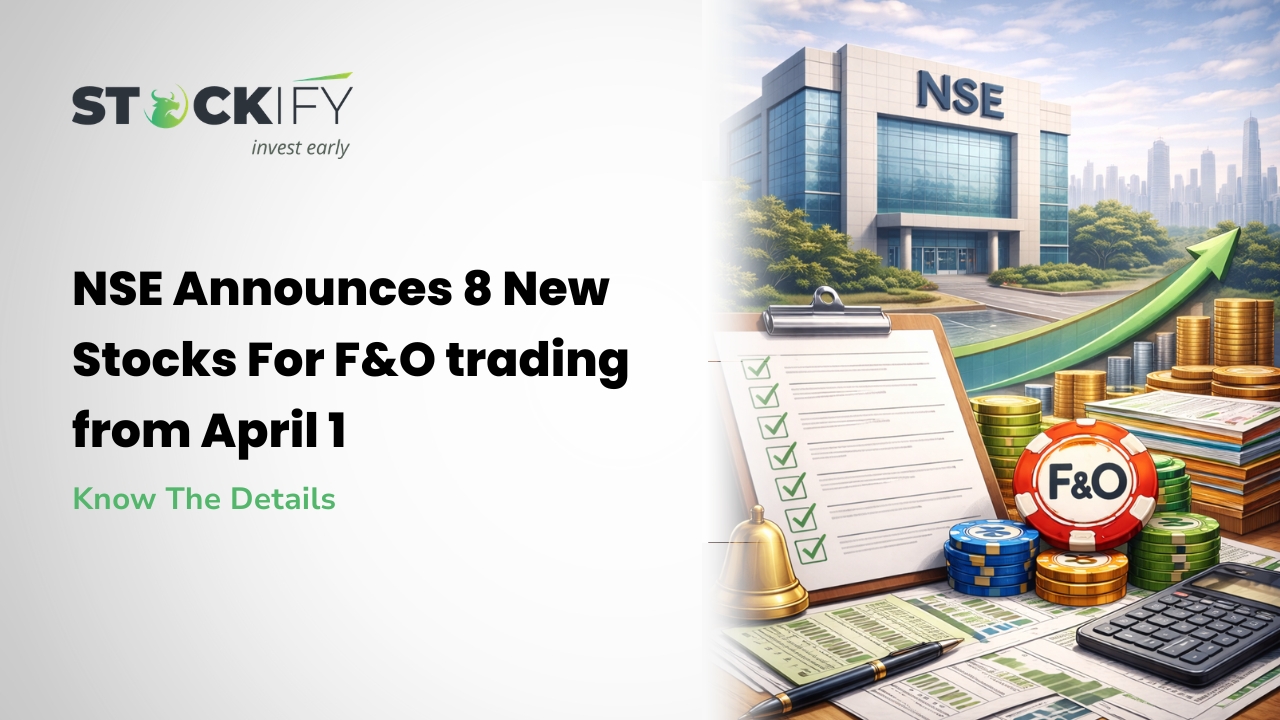
The National Stock Exchange of India has expanded its futures and options segment by adding eight new stocks effective April 1, 2026, signaling a shift in where trading activity, liquidity, and institutional attention may move in the coming months. The newly included stocks are Adani Power, Force Motors, Cochin Shipyard, Godfrey Phillips India, Hyundai Motor India, Motilal Oswal Financial Services, Nippon Life India Asset Management, and Vishal Mega Mart. With this inclusion, these companies transition from being purely investment-driven stocks to actively traded instruments within the derivatives ecosystem.
Lot Sizes and Capital Requirements
Each of these stocks comes with a predefined lot size, which determines the minimum capital required to participate in derivatives trading. For instance, Force Motors has a relatively small lot size of 25 shares, making it more accessible, while Vishal Mega Mart carries a much larger lot size of 4,850 shares, requiring significantly higher capital commitment. Other stocks such as Adani Power (3,550 shares), Cochin Shipyard (400 shares), and Nippon Life India (625 shares) fall in between, offering varied exposure depending on the trader’s risk appetite and capital base. These lot sizes are carefully structured to maintain uniform contract values and ensure efficient participation across different price ranges.
SEBI Criteria for F&O Inclusion
The inclusion of these stocks in the F&O segment is not random or discretionary. It is governed by strict eligibility criteria defined by the Securities and Exchange Board of India. To qualify, stocks must rank among the top 500 in terms of average daily market capitalisation and traded value over a six-month rolling period.
Additionally, they must meet thresholds related to market-wide position limits, which must exceed Rs 1,500 crore, ensuring that there is sufficient depth for derivatives trading. Other important filters include a minimum average daily delivery value of Rs 35 crore and a median quarter-sigma order size of at least Rs 75 lakh. These criteria ensure that only liquid, stable, and institutionally relevant stocks are introduced into the derivatives segment.
What F&O Inclusion Signals
The real significance of F&O inclusion lies in what it represents for a stock’s lifecycle. Entry into this segment typically leads to higher liquidity, increased trading volumes, and wider participation from institutional investors, proprietary desks, and sophisticated traders.
It enhances price discovery, as both bullish and bearish views can now be expressed through futures and options. At the same time, it also introduces higher volatility, since leveraged positions and hedging strategies amplify price movements in the short term. Historically, stocks entering the F&O segment often witness a surge in trading activity, although the direction of price movement depends on broader market sentiment.
What Investors and Traders Should Watch
For investors and traders, this development creates both opportunity and responsibility. While the expanded F&O universe allows for better hedging, arbitrage, and speculative strategies, it also requires a deeper understanding of derivatives, margin requirements, and risk management.
Early phases after inclusion are often marked by sharp movements and evolving open interest patterns, making it crucial to track institutional positioning, volume trends, and volatility closely.
You may also like to read

What Are The Different Classes Of Shares Issued In India?

Different Classes of Assets In The Financial Market

Follow These Simple Share Market Tips While Investing
Importance of Investing in Unlisted Shares

Pre IPO Success Stories To Start Your Unlisted Share Trading

Step-by-step Process Of Transferring Unlisted Shares (Off-market)

What Is The Expected Return Of Unlisted Shares?

Common Mistakes To Avoid While Investing In Unlisted Shares

Know Your Tax Implications Before Investing In Unlisted Shares
How To Pick Best Performing Unlisted Stocks in India?

A Detailed Guide On How To Buy Unlisted Shares In India

Risks And Rewards Associated With Unlisted Share Investment

Difference Between Start-Up Investing And Unlisted Shares?

IPO Process in India: Key Steps Explained Clearly

Revealed: The Real Picture of Unlisted Shares in Grey Market

Key Financial Ratios And How To Use Them To Analyse Your Investment

10 Golden Rules Of Investing In Stock Market

101 Guide For Beginners: What Is Pre IPO Share Market?

Listed Shares Vs. Unlisted Shares - Detailed Comparison

The Dark Side of Paytm's IPO Explained In Details

What Leads to Delisting of Shares and What Goes Behind The Scenes?

When Should You Review Your Portfolio Professionally?

In-Depth Analysis of Pre-IPO Shares for Portfolio Growth

PharmEasy Unlisted Price Falls 70%. Here's why

Delaying Pre-IPO Investments? Here’s What You Risk

An NRI’s Guide To Invest In Unlisted Shares In India

Guide To Filter The Most Profitable Unlisted Companies In India

A Comprehensive Guide On Follow-on Stocks

Smart Strategy to Buy & Sell Unlisted Shares Professionally

Care Health Insurance

Top Highly Profitable Unlisted Companies In India To Look For As An Investor

Upcoming IPOs In 2022-2023

Capgemini Unlisted Shares: Is The Risk Worth?

Expert’s Driven Roadmap To Research A Startup IPO

HDFC Sec vs HDB Financial: Which Is the Better Pick?

Detailed Guide To Calculate Capital Gains on Unlisted Shares

Dematerialisation of Unlisted Shares and Its Impact On Shareholders

How are B9 Beverages Pvt Ltd (Bira91) Unlisted Shares Gaining Pace Again?

Reliance Retail: The Success Story of India's Largest Retail Brand

The Future Of Unlisted Shares In the Fintech Market
Employee Stock Ownership Plan: What, How, and Why?

Studds Unlisted Shares: 6 Reasons to Buy Now

LAVA’s Unlisted Shares Soar Under Atmanirbhar Push
NSE vs BSE: Detailed 101 Market Share Comparison

The Role Of Corporate Governance And Management In Unlisted Companies

The Future Outlook For Unlisted Shares As An Investment Option

How to Buy and Sell Unlisted Shares in India?

The Benefits And Drawbacks Of Investing In Unlisted Shares
What's Temperature Ahead Of Tata Technologies' ₹4,000 Cr. IPO?