

1.jpg)
Table of Contents
Buy/Sell Your Unlisted Shares
Submit the details below to share a quote.
TL;DR
Vedanta plans to list four demerged units on Indian exchanges by mid May, following tribunal approval and a demerger effective from April 1.
Introduction
Vedanta shares turned ex-demerger on Wednesday, and the market immediately began pricing the stock on a revised basis. It led to a drop of 6% in the special price discovery session. The decline was the outcome of value being separated into multiple listed businesses under the vedanta demerger plan.
Vedanta Demerger: Why the Stock Moved Sharply?
The sharp move in Vedanta’s share price was driven by the mechanics of the vedanta demerger,not by any sudden deterioration in operating performance. On 30th April, 2026, the stock went through a special pre-open price discovery session, and the market immediately repriced Vedanta Limited without the value of the four businesses being carved out of the parent company.
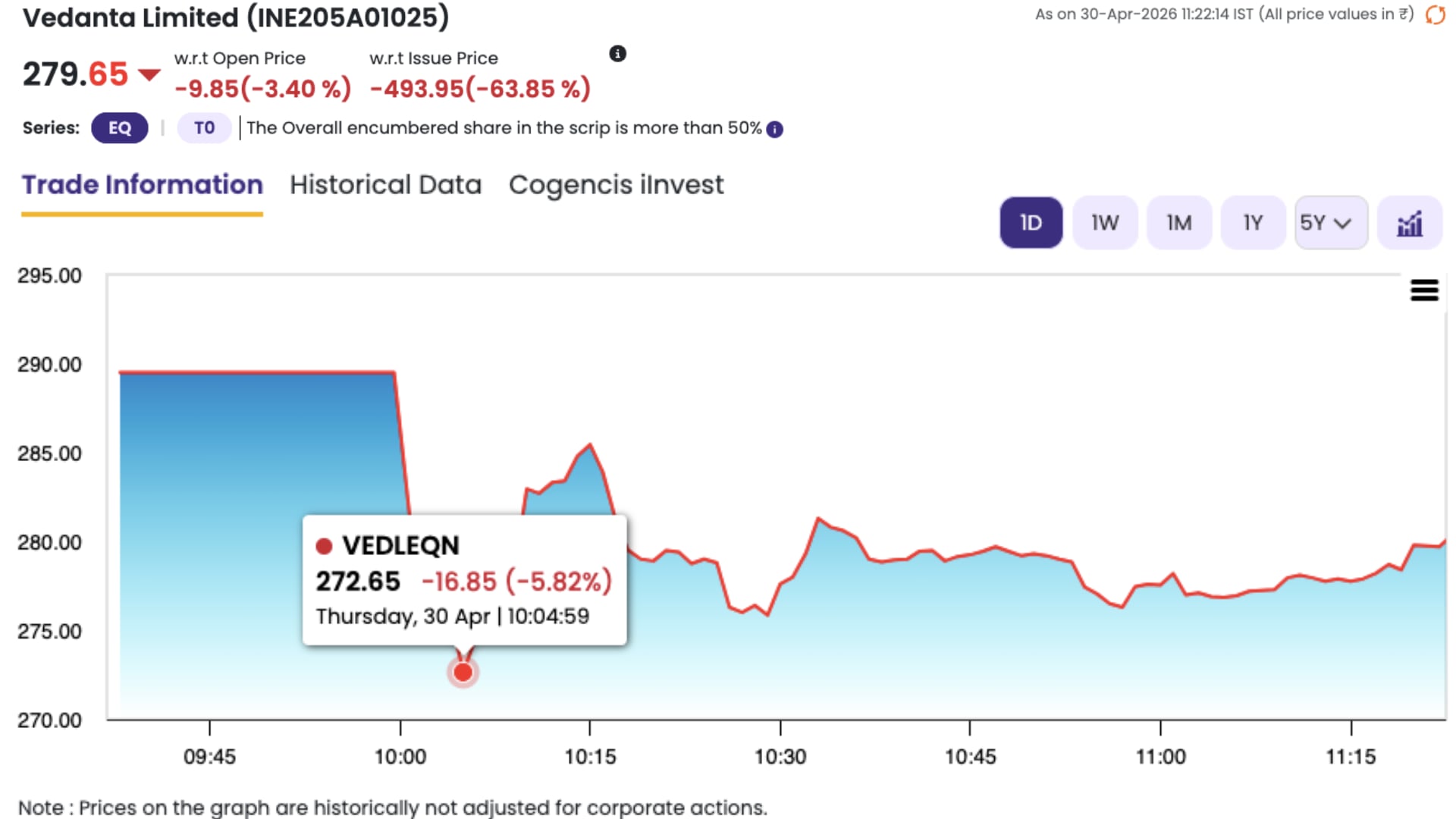
Source: NSE
Vedanta closed at about ₹773.6 on 29 April 2026, but after the special session the stock was discovered at around ₹289.5 on the NSE. It implied a drop of roughly 62% in the ex-demerger trade.
The fall looks dramatic but it mainly reflects the removal of value that now sits in the de-merged entities rather than a destruction of shareholder wealth.
The company will be split into five listed entities. Eligible shareholders of these new five companies (will receive one share each for power, aluminium, oil and gas, and iron & steel businesses) in the new for every Vedanta share they hold.
The company declared 30 April 2026 became the ex-effective date for the price adjustment.
There is a steep reset in the price. ICICI securities, as cited in reports, pegged the post-demerger Vedanta price in the ₹300–₹325 range against the previous market price of around ₹720-₹774 before the adjustment. The market was recalculating the stock on a standalone basis after striping out the value of the spun-off businesses. (Business Standard)
What the Demerger Changes?
Vedanta is being reorganised into five separately listed companies:
Vedanta Aluminium
Vedanta Oil &Gas
Vedanta Power
Vedanta Iron and Steel
The Residual Vedanta Limited
The demerger does not reduce value for Vedanta does not reduce value. And it is good for the long-term investors if the market assigns stronger valuation to individual businesses than it did to the larger conglomerate.
Record Date, Ex-Date and Entitlement
Vedanta fixed May 1, 2026 as the record date as well as the effective date. But the day being a holiday, April 30, 2026 is declared as the ex-date.
Under the T+1 settlement cycle, 29 April 2026 was the last day to buy Vedanta shares and still qualify for the entitlement under the scheme.
The entitlement ratio is 1:1, which means eligible shareholders will receive one share in each of the four new companies for every share they hold in Vedanta Ltd. That structure is important because it helps investors understand that the drop in the parent stock is being offset by ownership in the spun off businesses. (AngleOne)
Why Investors Are Watching Closely
The real story for investors is not just the immediate decline, but what happens next. In the time to come, the market will assign individual valuation to each of the new listed entities. And, the prices for the five entities will be influenced by sector outlook, earnings visibility, capital allocation, and balance-sheet strength.
Because of this, the long-term investors and traders are closely watching all aspects of Vedanta demerger. A demerger can unlock hidden value if each business performs well independently, but the transition period often brings volatility as markets reprice the parent and wait for new listings.
What Does the Current Fall Means?
A fall of over 6% after the ex-demerger session should be read as a technical reset rather than a standalone negative signal.The parent stock has simply moved to an adjusted price that reflects only the retained business, while shareholders continue to receive exposure to the de-merged units through the entitlement structure.
For Vedanta investors, the next key trigger will be listing of the newly de-merged companies, which will show whether the restructuring creates a valuation uplift over time.
Conclusion
Vedanta demerger has triggered a major repricing event, and the sharp decline in Vedanta’s share price should be read in that context. After the stock traded ex-demerger, the parent company was left with only the value of the retained business. And with that the carved out units will move into their own future listing journey.
For investors, the important takeaway is that the immediate fall is only one part of the story. The next phase will depend on how the market values each de-merged entity separately, whether the new listing attracts strong institutional interest.
FAQs
Why did Vedanta shares fall after the demerger session?
Vedanta shares fell because the market adjusted the stock to reflect the removal of value tied to the four demerged businesses.
Is the loss of Vedanta share price a loss for shareholders?
The drop reflects a re-distribution of value across multiple listed companies, and eligible shareholders are set to receive shares in the new entities under the entitlement ratio.
What was the special price discovery session?
It was a pre-open session held on 30 April 2026 to determine the ex-demerger price of Vedanta Ltd before normal trading began.
What is the entitlement ratio in the Vedanta demerger?
The entitlement ratio is 1:1.
You may also like to read

What Are The Different Classes Of Shares Issued In India?

Different Classes of Assets In The Financial Market

Follow These Simple Share Market Tips While Investing

Importance of Investing in Unlisted Shares

Pre IPO Success Stories To Start Your Unlisted Share Trading

Step-by-step Process Of Transferring Unlisted Shares (Off-market)

What Is The Expected Return Of Unlisted Shares?

Common Mistakes To Avoid While Investing In Unlisted Shares

Know Your Tax Implications Before Investing In Unlisted Shares

How To Pick Best Performing Unlisted Stocks in India?

A Detailed Guide On How To Buy Unlisted Shares In India

Risks And Rewards Associated With Unlisted Share Investment

Difference Between Start-Up Investing And Unlisted Shares?

IPO Process in India: Key Steps Explained Clearly

Revealed: The Real Picture of Unlisted Shares in Grey Market

Key Financial Ratios And How To Use Them To Analyse Your Investment

10 Golden Rules Of Investing In Stock Market

101 Guide For Beginners: What Is Pre IPO Share Market?

Listed Shares Vs. Unlisted Shares - Detailed Comparison

The Dark Side of Paytm's IPO Explained In Details

What Leads to Delisting of Shares and What Goes Behind The Scenes?

When Should You Review Your Portfolio Professionally?

In-Depth Analysis of Pre-IPO Shares for Portfolio Growth

PharmEasy Unlisted Price Falls 70%. Here's why

Delaying Pre-IPO Investments? Here’s What You Risk

An NRI’s Guide To Invest In Unlisted Shares In India

Guide To Filter The Most Profitable Unlisted Companies In India

A Comprehensive Guide On Follow-on Stocks

Smart Strategy to Buy & Sell Unlisted Shares Professionally

Care Health Insurance

Top Highly Profitable Unlisted Companies In India To Look For As An Investor

Upcoming IPOs In 2022-2023

Capgemini Unlisted Shares: Is The Risk Worth?

Expert’s Driven Roadmap To Research A Startup IPO

HDFC Sec vs HDB Financial: Which Is the Better Pick?

Detailed Guide To Calculate Capital Gains on Unlisted Shares

Dematerialisation of Unlisted Shares and Its Impact On Shareholders

How are B9 Beverages Pvt Ltd (Bira91) Unlisted Shares Gaining Pace Again?

Reliance Retail: The Success Story of India's Largest Retail Brand

The Future Of Unlisted Shares In the Fintech Market
Employee Stock Ownership Plan: What, How, and Why?

Studds Unlisted Shares: 6 Reasons to Buy Now

LAVA’s Unlisted Shares Soar Under Atmanirbhar Push
NSE vs BSE: Detailed 101 Market Share Comparison

The Role Of Corporate Governance And Management In Unlisted Companies

The Future Outlook For Unlisted Shares As An Investment Option

How to Buy and Sell Unlisted Shares in India?

The Benefits And Drawbacks Of Investing In Unlisted Shares
What's Temperature Ahead Of Tata Technologies' ₹4,000 Cr. IPO?