


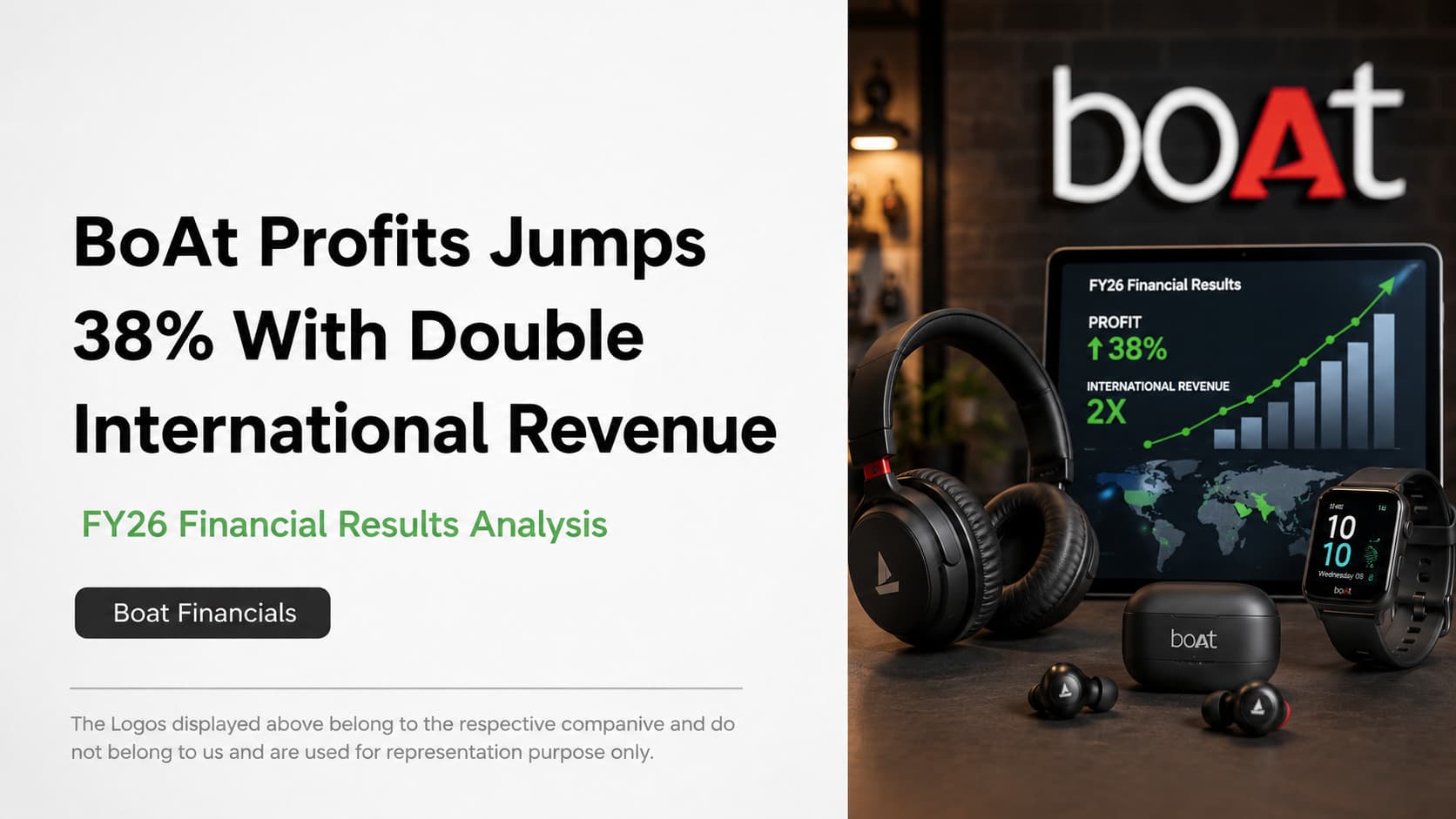
boAt has become one of India's best-known consumer electronics brands, especially in personal audio and wearables. But after a few years of pressure on revenue, an important question is whether the company is now moving towards healthier and more sustainable growth. Its FY25-26 financials give an interesting answer. Revenue from operations fell 4.6% to about Rs.2,931 cr, but profit after tax (PAT) increased 38% to Rs.84.5 cr. Profit before tax also rose sharply to Rs.114.3 cr. So, what changed? Let’s take a closer look.
boAt FY26 Financial Analysis
Particulars (in Rs. Cr) | FY25 | FY26 | Change |
Revenue from operations | 3,073 | 2,931 | -4.6% |
Profit before tax | 74.7 | 114.3 | 53% |
Profit after tax | 61.1 | 84.5 | 38% |
ROCE | 11.5% | 15.2% | Improved |
Cash reserves | - | Rs. 397 Cr | Strong liquidity |
Bank debt | - | Zero | Improved |
Source: Imagine Marketing Limited FY26 financial disclosures and FY26 Annual Report.
Revenue Fell Again in FY26
boAt's revenue from operations declined from around Rs.3,073 cr in FY25 to Rs.2,931 cr in FY26, a fall of about 4.6%. This is something investors cannot ignore. The company has faced pressure on its top line for several years. Its revenue had been around Rs.3,377 Cr in FY23, before falling to roughly Rs.3,118 Cr in FY24, Rs.3,073 Cr in FY25 and Rs.2,931 Cr in FY26. So, while profitability improved, revenue growth could still be the biggest area boAt needs to fix.
The biggest takeaway is that boAt made more profit even though it sold less. That means the improvement came mainly from better profitability and financial discipline rather than from revenue growth.
Why Did boAt's Profit Improve?
There was no single reason. A few changes worked together.
1. Finance Costs Fell Sharply
One of the clearest improvements was in finance costs. Finance costs fell by about 72%, to around Rs.7.9 cr in FY26. The company also repaid around Rs.60 cr of short-term borrowings during the year.
2. Wearables Turned Profitable
This is probably one of the most important developments in the FY26 results. boAt's wearables business had made a loss of around Rs.54 cr in FY25. In FY26, the segment reported a profit of around Rs.7 cr. It shows that in just 1 year, profitability improved by roughly Rs.61 cr.
Now, it matters because, being an important part of boAt's product strategy, the category struggled to generate profits previously. Hence, it could mean that boAt would have become more consistent about products, pricing and costs in this segment.
3. Other Categories Became More Profitable
boAt is also trying to build businesses outside its traditional audio products. Its Other segment includes areas such as:
Charging solutions
Cables
Gaming products
Other consumer technology products
Profit from this segment increased from around Rs.14 cr in FY25 to Rs.46 cr in FY26. That is more than a threefold increase. This is important because it shows that newer categories are beginning to contribute to profitability rather than remaining small side businesses.
boAt Is Expanding Beyond Audio
Audio remains the foundation of boAt's business, but the company is looking to build additional growth engines. Its newer focus areas include:
Wearables
Charging solutions
Gaming
Grooming
Projectors
Premium audio
International markets
The company is also seeing early growth outside India. International revenue increased from around Rs.20 Cr in FY25 to Rs.45 Cr in FY26, although it remains a small part of the overall business. Overall, this could simply mean boAt wants to reduce its dependence on a single category and build multiple sources of growth.
Balance Sheet Looks Stronger
Metric (in Rs. Cr) | FY25 | FY26 | Change |
Inventory | 325.8 | 293.9 | -9.8% |
Trade receivables | 255 | 255 | Broadly stable |
Cash & cash equivalents | - | 83.8 | - |
Loan repayable on demand | 60.2 | Nil | Improved |
boAt also improved its balance sheet during FY26. Inventory declined from around Rs.326 Cr to Rs.294 Cr, a reduction of about 10%. As the new models enter the market, products can lose value quickly, So, keeping inventory under control might be important for a consumer electronics company. Stability can be seen broadly in trade receivables at around Rs. 255 cr. Also, ROCE improved from 11.5% to 15.2 in FY26, which could mean better use of capital.
Cash Flow: Something Investors Should Watch
Net cash from operating activities fell to Rs.93.5 Cr in FY26 from Rs.424.4 Cr in FY25. This means boAt generated much less cash from its regular business, even though its profit increased. For FY27, investors will want to see whether the company can keep its profits growing and also improve the cash it generates from the business.
What About boAt's Future Growth?
boAt is now looking beyond its core audio business. Under its “boAt 2.0” strategy, the company is focusing on areas such as wearables, charging products, gaming, grooming, projectors and international markets. These newer businesses could give boAt more ways to grow. But they will need to become bigger and generate steady revenue over time.
Overall, FY26 was a better year for boAt's profitability, but revenue growth is still a challenge. PAT rose 38% to Rs.84.5 Cr, while revenue fell 4.6% to Rs.2,931 Cr. For investors tracking the boAt unlisted share price, the next step will be to see whether the company can bring sales growth back while keeping profits on track. So, in FY27, the key question arises that, can boAt grow its revenue again without giving up the profit gains it made in FY26? If it can, FY26 could prove to be an important step towards its next phase of growth.


1.jpg)