


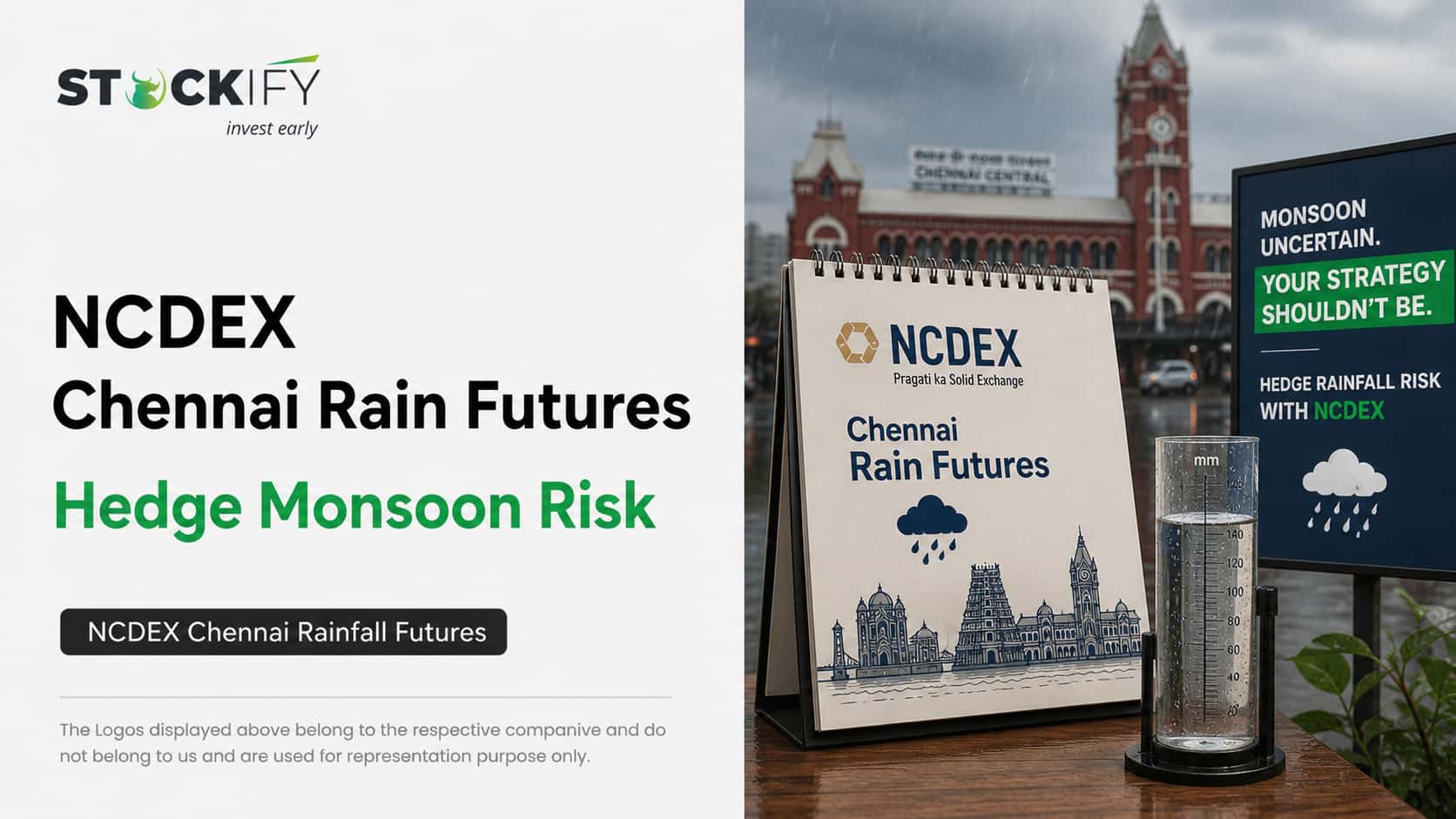
NCDEX has introduced RAINCHNNAI, a cash-settled rainfall futures contract that lets businesses and traders hedge financial exposure to Chennai’s Northeast monsoon.
What is NCDEX Chennai Rainfall Futures
RAINCHNNAI is an exchange-traded, cash settled futures contract launched by NCDEX on August 31, 2026. The idea is to hedge financial risk linked to Chennai’s rainfall during the Northeast Monsoon. (Source: ET dated 31st August,2026)
The contract is based on the Cumulative Deviation Rainfall (CDR) model, which tracks how much actual rainfall in Chennai deviates from its Long Period Average (LPA) over the monsoon month.
Why Chennai Needs a Northeast Monsoon Hedging Tool
Chennai is highly sensitive to monsoon variability, as close to 70% of its annual rainfall is contributed by the Northeast monsoon.
Both deficit and excess rainfall may affect agriculture, water supply, power demand, logistics, retail and insurance-linked exposures across Tamil Nadu and adjoining areas.
Before RAINCHNNAI, market participants had limited exchange traded tools to hedge such weather-linked financial risks in India.
By adding Chennai to its Rainfall derivatives suite (after RAINMUMBAI for the Southwest Monsoon), NCDEX now covers both major monsoon seasons through listed contracts.
How NCDEX Chennai Rainfall Futures RAINCHNNAI Work
1. Underlying index and rainfall stations
The underlying is the CDR from LPA for Chennai.
Rainfall data comes from IMD surface observations at two stations: Meenambakkam and Nungambakkam.
The model builds on decades of IMD data and experience from the earlier RAINMUMBAI contract.
2. Contract months, tick size, and margins
Contract months: September, October, November, December (Northeast monsoon window).
Tick size: 1 mm of rainfall deviation.
Lot multiplier: Rs. 50 per mm.
Maximum order size: 50 lots per trade.
Minimum initial margin: 10%.
Daily price limits: Initial 6%, enhanced slab 3%, aggregate 9%.
Trading hours: Monday-Friday 10:00 AM-11:55 PM.
Open interest threshold: 116,400 mm (for concentration margin). (Source: businesstoday)
3. Cash settlement and final settlement price
RAINCHNNAI is cash‑settled; there is no physical delivery of any commodity.
The final settlement price is the CDR spot value on the expiry day, based on IMD data.
The last trading day is the business day immediately before the last calendar day of the contract month.
Who is the Chennai Rain Futures for?
Standard users are:
Agri-input companies, traders and processors linked to monsoon dependent demand.
Power distributors and generators are facing swings in load and revenue as demand patterns are driven by rain.
Insurers and Reinsurers wanting to hedge Portfolio Level Monsoon Risk, in addition to traditional products.
Corporates and treasuries exposed to logistics, retail or infrastructure connected to rainfall in Chennai/Tamil Nadu.
Speculators and proprietary traders offering liquidity for weather derivatives.
RAINCHNNAI VsTraditional Rain Insurance
Aspect | RAINCHNNAI Futures | Traditional Rain Insurance |
Payout trigger | Rainfall index (CDR vs LPA) from IMD stations | Loss assessment or predefined index, often policy‑specific |
Settlement | Exchange‑traded, cash‑settled, standardised | Bilateral contract, claim‑based settlement |
Basis risk | Depends on how well station data matches exposure | Depends on policy wording and loss proof |
Liquidity | Potentially tradable, mark‑to‑market daily | Usually illiquid, held to maturity/claim |
Margin & leverage | Initial margin ~10%, daily MTM | Premium paid upfront, no daily MTM |
Risks and Limitations to Consider
1. Basis Risk-Index vs Real Exposure
RAINCHNNAI pays out based on rainfall measured at two IMD stations (Meenambakkam and Nungambakkam), not on a company’s actual losses or city‑wide rainfall.
A firm may have operations spread across Chennai metro, suburbs, or other parts of Tamil Nadu, where rainfall can differ from the two reference stations. In some years, the index could show a large deviation (triggering a payoff) while the firm’s actual business impact is small, or vice versa.
The hedge may over‑compensate or under‑compensate relative to true economic loss. Companies need to quantify their rainfall sensitivity (e.g., revenue vs rainfall buckets) and test how closely RAINCHNNAI’s index tracks that exposure before sizing positions.
2.Model Risk-Dependence on CDR and Historical Averages
The contract uses a Cumulative Deviation Rainfall (CDR) model that compares actual rainfall to a Long Period Average (LPA) built from historical IMD data.
If rainfall patterns shift due to climate change, urbanisation, or land‑use changes, the historical LPA may become less representative of “normal” rainfall. The CDR formula itself (choice of period, stations, aggregation method) determines payouts; any mismatch between the model and a user’s risk profile creates structural basis risk.
Over long horizons, the hedge may behave differently than expected if rainfall distributions change. Users should periodically review the relevance of LPA and CDR for their specific exposure and consider combining RAINCHNNAI with other hedges or buffers.
3. Liquidity risk-thin order books in early stages
RAINCHNNAI is a new contract (August 2026) so trading volumes and open interest may be low initially relative to mature commodity or equity derivatives.
Large orders may move the price more than expected, especially near expiry or in less active contract months.
Corporates and institutions may need to build or unwind positions gradually to minimise market impact. Also, the risk managers should factor in execution costs and slippage when estimating hedge effectiveness and overall cost of protection.
4. Regulatory and Margin Changes-Evolving Contract Terms
As a SEBI‑regulated exchange product, RAINCHNNAI’s margins, price limits, position limits, and other contract specifications can be revised by NCDEX/SEBI as the market develops.
An increase in initial or concentration margins can raise the capital required to maintain hedges. Changes in daily price limits or settlement rules can affect how quickly positions can be adjusted during volatile rainfall outcomes.
Conclusion
RAINCHNNAI gives Chennai‑focused businesses a listed, transparent tool to convert uncertain monsoon outcomes into a tradable, cash‑settled payoff linked to IMD rainfall data. For treasuries, insurers, and agri‑linked firms, it can sit alongside traditional insurance and operational hedges to build a more complete monsoon risk framework.
The product’s effectiveness will depend on liquidity, basis management, and how well the CDR index tracks each user’s true exposure. As NCDEX expands its weather derivatives suite, RAINCHNNAI marks a practical step toward deeper climate‑risk markets in India.
FAQ
What is RAINCHNNAI?
RAINCHNNAI is NCDEX’s cash‑settled rainfall futures contract for Chennai, designed to hedge financial risk from Northeast monsoon variability.
What months are included in the contract?
The first contracts are for the September, October, November and December expirations, which correspond to the Northeast monsoon season.
How is the rainfall index calculated?
A Cumulative Deviation Rainfall (CDR) model based on IMD data of Meenambakkam and Nungambakkam stations which measures deviation of actual rainfall from Long Period Average.
Is RAINCHNNAI physically settled?
No. It is cash‑settled based on the final CDR spot value; there is no delivery of any physical commodity.
What is the minimum margin required?
The minimum initial margin is 10% of the contract value, subject to NCDEX/SEBI rules and daily mark‑to‑market.
Who can trade in RAINCHNNAI?
Corporates, institutions and individual traders can trade through the registered brokers as per the NCDEX / SEBI norms. Trading derivatives is open to qualified market participants.
How is RAINCHNNAI different from RAINMUMBAI?
RAINMUMBAI hedges Mumbai’s Southwest monsoon (June–September), while RAINCHNNI hedges Chennai’s Northeast monsoon (September–December), using city‑specific rainfall stations and LPA.
.webp)