



TL:DR
NSE equity shares were admitted for trading on Metropolitan Stock Exchange of India (MSEI) from September 24, 2026, under the "Permitted to Trade" category, alongside their primary listing on the BSE.
MSEI's average daily cash-market turnover was around Rs.4.9 billion this month, dwarfed by NSE's own Rs.1.1 trillion and BSE's roughly Rs.100 billion daily average, per Bloomberg-compiled data.
NSE's IPO-India's second-largest ever at Rs.22,561.57 crore-was subscribed 5.71 times overall, with QIBs bidding 12.68x and retail at 1.39x.
The stock debuted on BSE at Rs.1,800 (0.84% premium to the Rs.1,785 issue price) and closed day one at Rs.1,818, up 1.85%.
MSEI itself had raised Rs.1,240 crore across two funding tranches.
NSE commands 92.99% of India's cash market turnover and 99.79% of equity futures turnover in FY26, per Redseer data cited in IPO filings.
Why NSE Shares Are Now Live on MSEI
Trading members of the Metropolitan Stock Exchange of India received a circular on September 23, 2026, confirming that NSE's equity shares would be "admitted for trading on the Capital Market Segment of the Exchange under 'Permitted to Trade' category" starting September 24 . This designation lets investors buy and sell NSE stock on MSEI without the company formally listing there-a regulatory workaround since a recognised stock exchange cannot list its own shares on its own platform under Sebi's Stock Exchanges and Clearing Corporations Regulations, 2018.
That's also why NSE shares never traded on the NSE itself. Instead, the exchange debuted on the BSE on September 24, with MSEI added as a parallel trading venue on the same day.
MSEI's Real Trading Numbers vs NSE and BSE
MSEI's average daily cash-market turnover stood at roughly Rs. 4.9 billion so far in September 2026. Compare that with:
NSE's own average daily cash-market turnover: approximately Rs.1.1 trillion
BSE's average daily cash-market turnover: approximately Rs.100 billion
That places MSEI's turnover at less than 0.5% of NSE's and under 5% of BSE's daily activity. The gap underlines why brokerages see the MSEI listing as a liquidity experiment rather than a meaningful shift in trading volumes-at least for now.
How NSE performed on MSEI till September 25, 2026 after its long-awaited listing can be found from the information below.
NSE Share Price
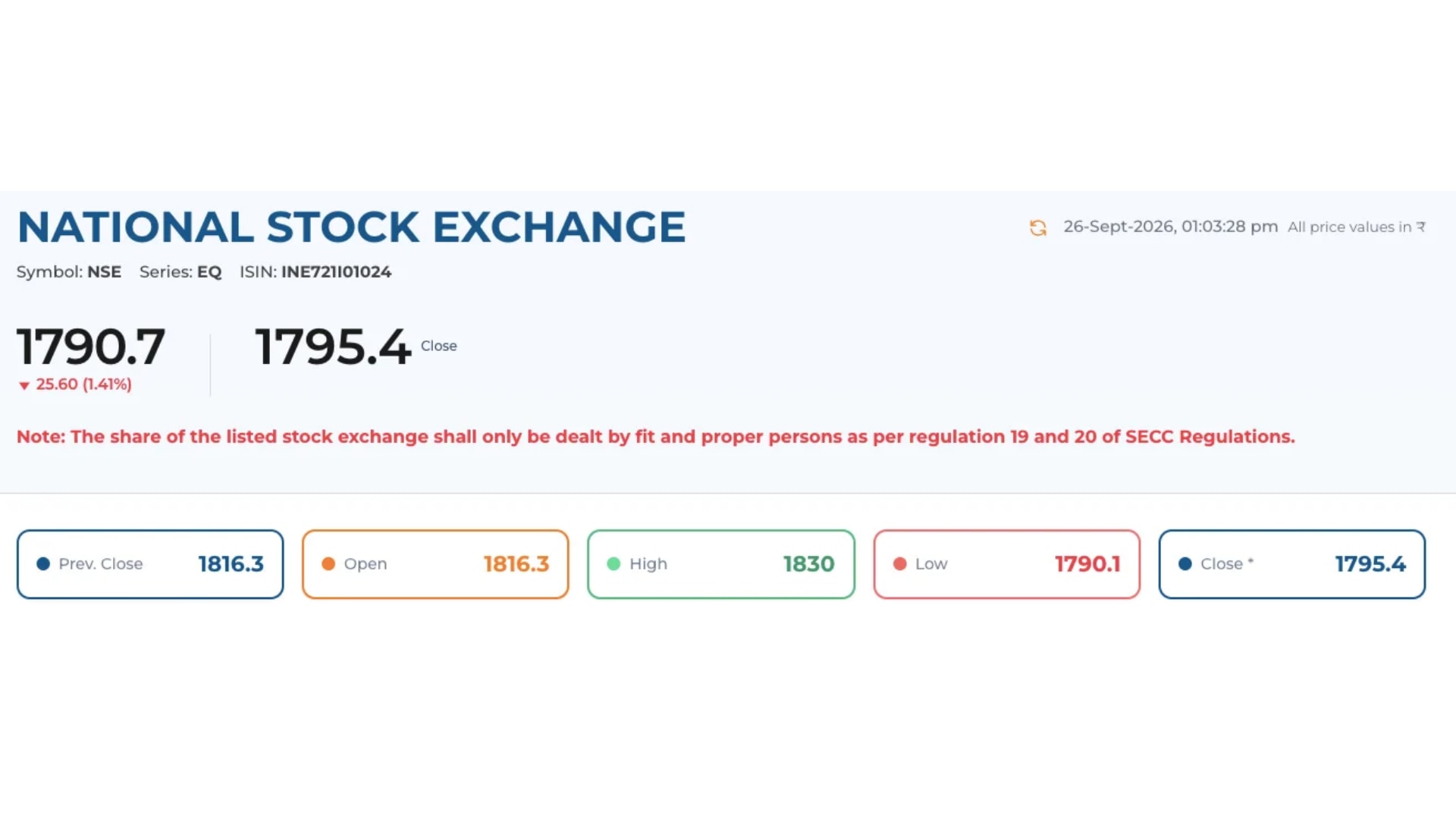
Source: MSEI
On this trading session:
The security recorded a traded volume of 84,093 shares with a traded value of Rs.1,517.56 lakh, spread across 2,758 trades, giving an average trade price (ATP) of Rs.1,804.62.
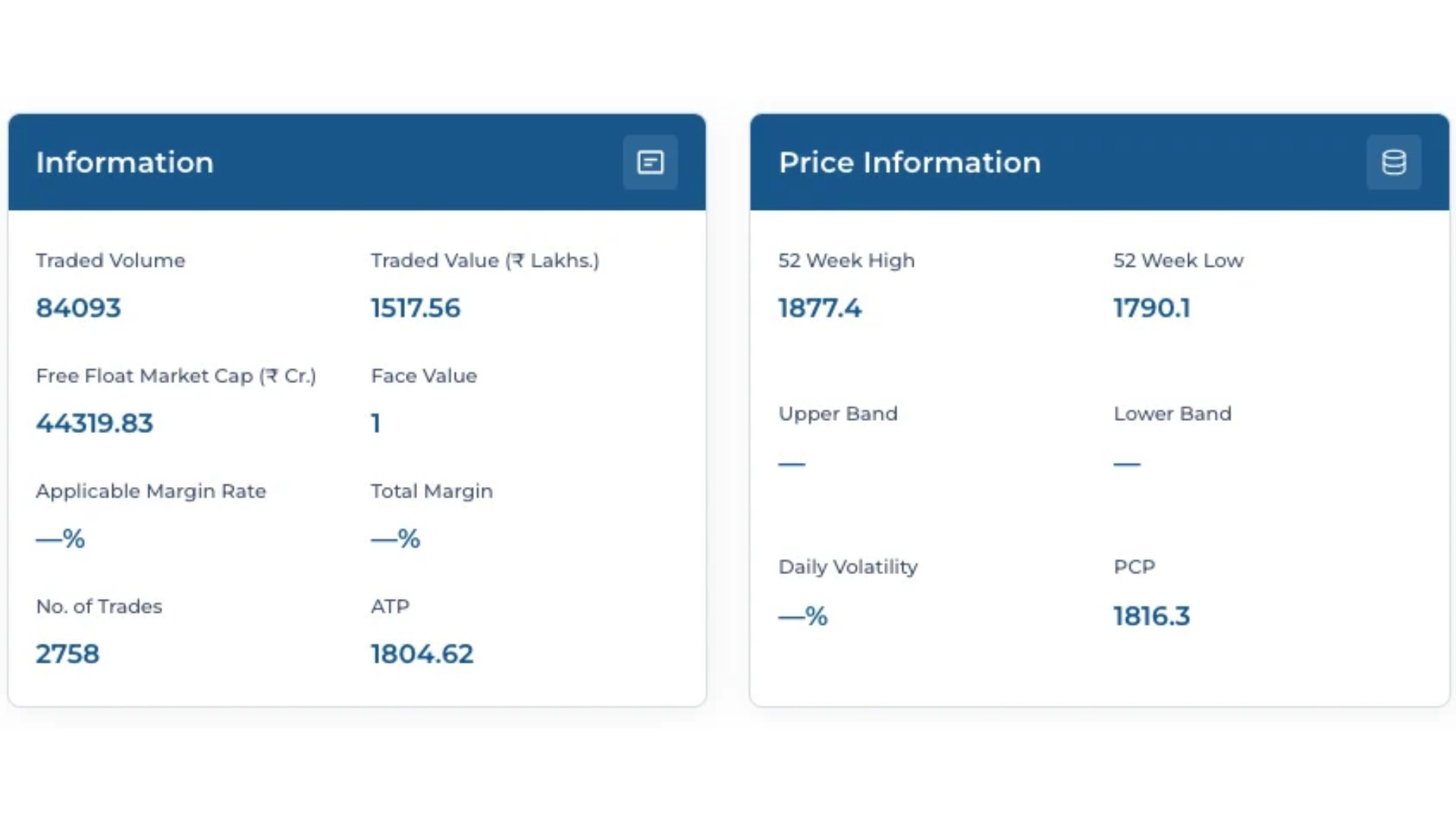
Its 52-week high stands at Rs.1,877.40 and the 52-week low at Rs.1,790.10, with the previous close price (PCP) at Rs.1,816.30; upper and lower circuit bands, applicable margin rate, total margin, and daily volatility are not disclosed in this view.
As per the information on MSEI, the company carries a free-float market capitalisation of Rs.44,319.83 crore, belongs to the financial services/investment services and stock-broking industry, and its trading and listing status are both marked "Active" with no surveillance flags noted.
Notably, this data reflects the NSE stock's very recent admission for trading on the Metropolitan Stock Exchange of India (MSEI) on September 24, 2026, under the permitted-to-trade category, following its landmark IPO listing on BSE just a day earlier at an issue price of Rs.1,785, marking the culmination of a decade-long effort by India's largest bourse to go public.
Source: MSEI
NSE IPO and Listing Day Snapshot
Metric | Figure |
IPO size | Rs.22,561.57 crore |
IPO price band | Rs.1,700-Rs.1,785 per share |
Overall subscription | 5.71x |
Retail subscription | 1.39x |
NII subscription | 6.55x |
QIB subscription | 12.68x |
Listing price (BSE) | Rs.1,800 (0.84% premium) |
Day-1 closing price | Rs.1,818 (1.85% gain) |
Day-1 intraday high | Rs.1,878 (5.21% gain) |
Market cap at listing | Rs.4.63 lakh crore (intraday peak on Day-1 of listing-24.9.26 when stock moved to Rs.1,878/-) |
The IPO was entirely an offer for sale (OFS) of 12.64 crore shares, meaning NSE itself received no proceeds, the money went to existing shareholders who sold. Life Insurance Corporation was the single largest bidder, placing bids worth about Rs.4,500 crore.
NSE's Market Dominance by the Numbers
NSE's scale is central to why its MSEI listing generated so much attention. According to the Redseer's IPO-linked report and NSE's own disclosures include:
92.99% share of India's cash market turnover in FY26
99.79% share of equity futures turnover in FY26
74.71% share of equity options by premium turnover
World's largest derivatives exchange by contracts traded in calendar 2025 (FIA data)
3rd globally in equity trades by volume in 2025 (WFE data)
132.37 million unique registered investors as of June 2026, up from 30.87 million in March 2020, a 26.23% CAGR
261.36 million registered investor accounts, 1,328 trading members, and 3,005 listed entities as of June 30, 2026
Rs.474.08 lakh crore total market capitalisation of listed entities on its platform.
NSE's financials also strengthened into FY27: revenue from operations rose 13.1% year-on-year to Rs.4,560 crore in the June 2026 quarter, while net profit climbed to Rs.3,121 crore from Rs.2,811 crore a year earlier.
Conclusion
NSE's decision to make its shares available on MSEI, right alongside its BSE debut, adds a new layer to India's exchange landscape without changing where the real trading volumes sit. NSE and BSE together continue to process well over 99% of India's cash-market activity, while MSEI's few-billion-rupee daily turnover signals a long road to relevance.
If you’re a retail investor having MSEI as a parallel venue might still mean more choice once broker integrations are live, something to watch for as India’s exchange competition unfolds.
FAQs
When did NSE shares start trading on MSEI?
NSE equity shares were admitted for trading on MSEI's Capital Market Segment under the "Permitted to Trade" category from September 24, 2026, the same day NSE debuted on the BSE.
Why doesn't NSE trade on its own platform?
To avoid any conflict of interest in the regulatory and supervisory role of a recognized stock exchange under Sebi’s Stock Exchanges and Clearing Corporations Regulations, 2018, a recognized stock exchange is not allowed to list or trade its own shares on its own exchange.
How does MSEI's trading volume compare with NSE and BSE?
MSEI’s average daily cash-market turnover was about Rs.4.9 billion in September 2026, compared with about Rs.1.1 trillion for NSE and Rs.100 billion for BSE, a drop in the ocean of either exchange’s activity.
What was NSE's IPO subscription and listing price?
The Rs.22,561.57-crore NSE IPO was subscribed 5.71 times overall. Shares listed on the BSE at Rs.1,800, a 0.84% premium over the Rs.1,785 issue price, and closed day one at Rs.1,818.
What is NSE's market share in India's capital markets?
In FY26, the NSE had a 92.99% share of cash market turnover, 99.79% of equity futures turnover and 74.71% of equity options turnover by premium, according to Redseer data in its IPO filings.