

The electric vehicle (EV) revolution is likely picking up pace faster than many expected, especially in India. The global EV market is projected to grow from around $755 billion in FY24 to nearly $4,360 billion by 2033 at a steady CAGR of 21.5%. India is expected to outpace this growth significantly. Starting from a smaller base of $2.36 billion in 2024, the Indian EV market is projected to surge to around $164.42 billion by 2033, growing at an impressive 57% CAGR. Let’s explore the top EV stocks in India and what makes them worth tracking. In this blog, we will have a look at the following:
What Are EV Stocks?
Market Share Of EV Stocks in 2026.
What Is The Government Doing To Support EVs in India?
Top EV stocks List in India 2026.
Risks of investing in Indian EV stocks in 2026.
Benefits Of EV Stocks In India.
Factors To Look for Before Investing IN EV Stocks In India.
Why Should One Invest In EV Stocks?
What Are EV Stocks?
EV stocks are shares of companies involved in the electric vehicle (EV) industry. When you buy EV stocks, you’re investing in businesses that design, manufacture, or support electric cars and related technology. These companies could benefit from the global shift toward clean energy and reduced carbon emissions. As governments promote EV adoption through policies and incentives, demand for such businesses is likely to rise. Investing in EV stocks enables investors to participate in this long-term growth, although it also comes with risks due to high competition and evolving technology.
Market Share Of EV Stocks in 2026
According to IBEF, as of FY26, EV penetration has reached nearly 9.98% of total auto sales, with over 5.8 lakh EV units sold, where 2-3-wheelers contribute close to 90% of total volumes. At the same time, the broader EV market is expanding rapidly from around $3.2 billion in 2022 to an expected $113.9 billion by 2029. It indicates possibly massive long-term growth potential.
Globally, the electric vehicle market is growing, with its size estimated at around $755 billion in FY24 and expected to touch nearly $4,360 billion by 2033 with a CAGR of about 21.5%. However, the EV market in India might still be in its early stages, but it is likely expanding much faster. From a relatively small base of $2.36 billion in 2024, it is projected to increase to around $164.42 billion by 2033, showing a CAGR of over 57%.
What Is The Government Doing To Support EVs in India?
Strong policy push: India is targeting 30% EV adoption by 2030, showing a clear long-term commitment to electric mobility.
PM E-DRIVE Scheme: Around Rs.10,900 crore allocated to boost EV adoption and infrastructure and reduce dependence on fossil fuels.
PLI scheme boost: Incentives for auto & EV manufacturing increased significantly to Rs.2,818.85 crore (FY26), supporting local production and scaling.
FAME II impact: Over 16.29 lakh EVs supported so far, including over 14 lakh electric two-wheelers and thousands of buses.
Charging infrastructure growth: Plans to install more than 72,000 EV chargers by FY26, with above 8,800 already installed, improving accessibility.
Custom duty benefits: Tax relief on key battery materials like lithium, cobalt, and capital goods helps reduce EV costs.
State & R&D push: States like Tamil Nadu are building EV innovation hubs with dedicated R&D zones and funding support.
Bus electrification plan: The government aims to replace 8 lakh diesel buses with electric alternatives in the coming years.
Support for startups & MSMEs: Schemes now focus on domestic sourcing and encourage smaller players to enter the EV ecosystem.
Top EV Stocks List in India 2026
1. GFCL EV
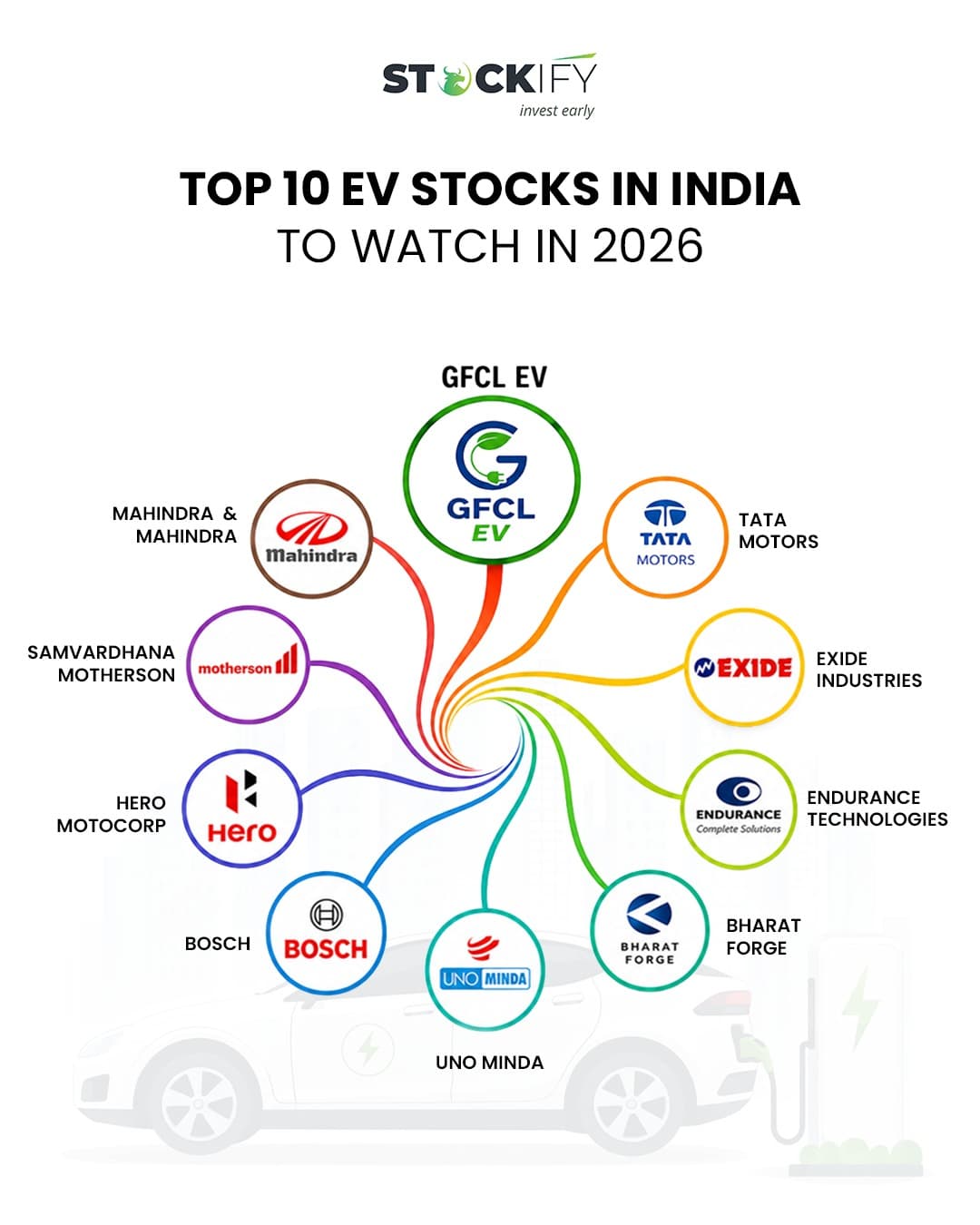
GFCL EV, part of Gujarat Fluorochemicals, operates in EV battery materials like LiPF₆, NaPF, PVDF, electrolytes, and LFP cathode materials. The GFCL EV had a revenue of Rs 30.4 Cr in FY25. It has raised around USD 130 million in funding from IFC and global investors. This funding includes $50 million from IFC and $80 million from global marquee investors. With subsidiaries in the USA, Europe, and Oman, it follows a global-first strategy. Backed by strong parentage, GFCL EV is possibly positioning itself in the fast-growing battery materials ecosystem.
GFCL EV Pre-IPO Share Price: Rs 40 per share
GFCL Market Cap: Rs 2,960.9 Crore
2. Mahindra & Mahindra (M&M)
Mahindra & Mahindra is one of India’s leading conglomerates with a strong presence in both the automotive and farm equipment sectors. As of April 30, 2026, the company remains a leader in the SUV and tractor markets while steadily expanding its footprint in the electric vehicle (EV) space.
Mahindra & Mahindra Share Price: Rs 3081 Per Share
Mahindra & Mahindra Market Capitalisation: Rs.3.83 lakh crore.
3. Tata Motors Ltd
Tata Motors Limited is a well-known global automobile company based in Mumbai and part of the Tata Group. As of April 2026, the company has taken a major step by splitting its business into two separate listed entities, focusing individually on commercial and passenger vehicles. Tata Motors continues to be a strong leader in India’s SUV and EV sector, with popular and well-received models driving its growth.
Tata Motors Share Price: Rs 383 Per Share
Tata Motors Market Capitalisation: Rs. 1.41 lakh crore.
4. Samvardhana Motherson International Ltd.
Samvardhana Motherson International Limited (SAMIL), earlier known as Motherson Sumi Systems. It is one of the world’s leading automotive component manufacturers, headquartered in Noida, India. The company focuses on key products like wiring harnesses, vision systems (mirrors), and polymer modules, serving major global OEMs. It currently has a market capitalisation of around Rs. 1.27 lakh crore.
Samvardhana Motherson Share Price: Rs 136 Per Share
Samvardhana Motherson Share Market Capitalisation: Rs. 1.43 lakh crore.
5. Hero MotoCorp Ltd.
Hero MotoCorp Limited is the world’s largest manufacturer of motorcycles and scooters, headquartered in New Delhi. As of April 2026, the company continues to hold a strong leadership position in India while actively expanding into the electric vehicle space through its Vida brand and investments in Ather Energy. It has a market capitalisation of around Rs.1.01 lakh crore.
Hero MotoCorp Share Price: Rs 4,966 Per Share
Hero MotoCorp Share Market Capitalisation: Rs. 99,366 crore.
6. Bosch Ltd.
Bosch is focusing on EV electrification through products like e-axles, electric motors, and vehicle control systems. Recently, it partnered with Tata AutoComp to manufacture these components in India, with operations expected to begin by mid-2026.
Bosch Ltd Share Price: Rs 36,310 Per Share
Bosch Ltd Share Market Capitalisation: Rs. 1,07,118 crore.
7. UNO Minda Ltd.
The company is expanding in EV electronics like sensors, charging control units, and high-voltage powertrains. It has taken full control of its EV joint venture and is investing Rs.423 crore in a new plant in Pune, expected to start production by late 2026.
Uno Minda Ltd Share Price: Rs 1,118 per share
Uno Minda Ltd Market Capitalisation: 64,624 Cr.
8. Bharat Forge Ltd.
While known for traditional forgings, it is now moving into EV-related aluminium components and machining. Its EV segment has started contributing to revenues, alongside its strong defence business.
Bharat Forge Ltd Share Price: Rs 1,918 per share.
Bharat Forge Ltd Market Capitalisation: Rs 91,712 Cr
9. Endurance Technologies Ltd.
Earlier focused on brakes and suspension, it is now entering EV batteries and BMS (Battery Management Systems). A new battery plant in Pune is set to launch in 2026 with capacity for around 35,000 packs per month.
Endurance Technologies Ltd. Share Price: Rs 2,801 per share.
Endurance Technologies Ltd. Market Capitalisation: Rs 39,426 Cr.
10. Exide Industries Ltd.
Exide is shifting from lead-acid to lithium-ion batteries. It is building a large gigafactory in India and expanding services like battery leasing while securing major EV orders.
Exide Industries Ltd Share Price: Rs 346 per share.
Exide Industries Ltd Market Capitalisation: Rs 29,418 Cr.
Risks of investing in Indian EV stocks in 2026
High dependence on government policies: The EV sector still relies heavily on subsidies and incentives like FAME and PLI. Any delay, reduction, or removal of these schemes can directly impact demand and company profitability.
Rising competition: The space is becoming crowded with strong domestic players and global entrants. This can lead to pricing pressure and reduced profitability, especially in segments like electric two-wheelers.
Expensive valuations & market volatility: Many EV stocks are already priced for future growth, which makes them sensitive to corrections. If adoption slows or market conditions weaken, stock prices can be volatile.
Technology risk: EV technology is evolving rapidly. Companies that fail to keep up with advancements in battery efficiency or cost reduction may lose market share to more innovative competitors.
Infrastructure gaps: While charging infrastructure is improving, it is still not widespread enough. Limited charging availability can slow down EV adoption, impacting overall industry growth.
Benefits Of EV Stocks In India
Strong innovation-led growth: EV companies in India are investing heavily in advanced battery tech, efficient drivetrains, and smart mobility solutions, creating new revenue opportunities beyond just vehicle sales.
Environmental advantage: Electric vehicles produce lower emissions compared to traditional fuel vehicles, supporting India’s goal of reducing pollution and building cleaner cities.
Government support boosts growth: Policies like subsidies, incentives, and schemes such as FAME and PLI are helping reduce costs, improve margins, and accelerate EV adoption across the country.
Diversified investment exposure: The EV ecosystem includes not just automakers but also battery manufacturers, auto component suppliers, and charging infrastructure companies.
Rising domestic and global demand: With increasing fuel prices and global focus on sustainability, both local consumption and export opportunities for Indian EV companies are expanding.
Factors To Look For Before Investing In EV Stocks
Policy & government support: EV companies in India are closely linked to government schemes and incentives. Keep an eye on budget announcements, subsidies, and policies like FAME or PLI, as even small changes can impact demand and pricing.
Market potential & positioning: Look at whether the company operates in a high-growth segment and how strong its presence is. Leaders with a clear market share or niche positioning tend to perform better over time.
Financial health of the company: Check revenue growth, profitability, and debt levels. Since EV is a capital-intensive industry, companies with strong balance sheets and steady cash flows are better equipped to survive volatility.
R&D investment: Continuous investment in research and development is crucial. Companies that spend on innovation are more likely to stay competitive, reduce costs, and launch better products in the future.
Production capacity & scalability: A company’s ability to scale production efficiently can directly impact its growth. Higher capacity often leads to better margins and the ability to meet rising demand without delays.
Distribution network & reach: Strong dealer networks and service reach across urban and rural areas help companies expand faster and improve customer accessibility.
Product portfolio: A diverse range of EV products helps companies cater to different customer segments and reduces dependence on a single revenue model.
Competitive landscape & partnerships: Evaluate how the company stands against competitors and whether it has strong global or domestic partnerships to access technology and scale faster.
Why Should One Invest In EV Stocks?
Investing in EV stocks can be a smart move as the sector is still in its early growth phase, especially in India. Government initiatives such as FAME II and PLI schemes, along with targets to increase EV adoption, may actively support the EV industry’s development. Rising fuel prices are also pushing consumers toward electric mobility, likely creating strong demand for EVs and related components. At the same time, India’s relatively low production costs and growing charging infrastructure are helping companies scale efficiently and improve profitability. GFCL EV is one such company leading India's EV Growth Story.

1.jpg)