


A stock that hasn’t done much for the better part of two decades just handed traders a 16% gain in two trading sessions. IFCI, the government-owned financial institution once known mainly for its bad loan troubles, briefly touched Rs.100 this week for the first time since the 2008 crash.
Nothing in IFCI's own quarterly numbers explain this move. The real trigger looks like National Stock Exchange’s decade long wait for a stock market listing is finally approaching a decision point. (Source: ET dated 3rd September, 2026)
Let us study here why IFCI has become the market favourite NSE-IPO proxy trade, what’s actually holding up SEBI’s approval and how big the IPO would be.
IFCI Share Price Action: The Numbers Behind The Rally
IFCI shares rose as much as 4% intraday on Thursday to touch Rs.101.60 on the BSE, building on a rally that pushed the stock up more than 16% across two sessions.
A day earlier, the stock had already spiked around 11-12%, at one point touching Rs.96.67 and later printing an intra-day high of Rs.98.32, a level not seen since January 2008.
IFCI’s all time high sits at Rs.121.20 which was in December 2007, so the stock is now trading within striking distance of a 17-year-old peak.
This sudden surge which has brought the share price above average is a sign of broad participation rather than a handful of large trades pushing the price around.
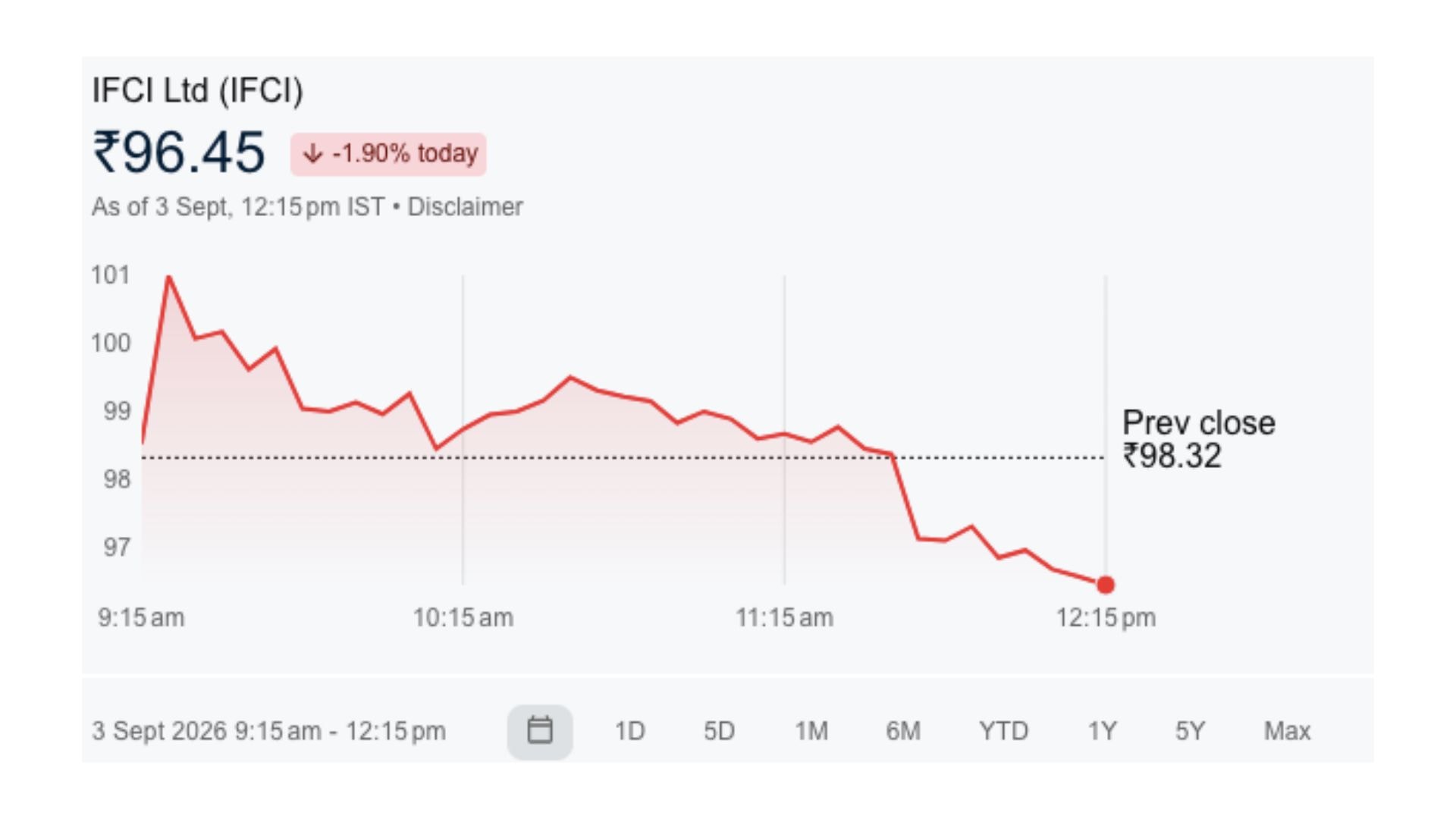
Source: Google
The SHICL Link: How is IFCI Share Price Actually Tied to NSE
Surprisingly, IFCI does not hold a single share of NSE, but what it owns is 50% stake in Stock Holding Corporation of India Limited (SHCIL), which is the country’s oldest custodian and depository participant. SHCIL separately holds a stake of just over 4% in NSE itself.
That makes IFCI’s NSE exposure indirect and diluted, but the market is trading it anyway for a simple reason. SHCIL currently carries its NSE stake on the books at historical cost, not anything close to the market value.
If NSE lists and its shares start trading at even a fraction of the buzzed about valuation, SHCIL’s holding gets revalued overnight. And that upside flows to IFCI as SHCIL’s majority owner.
It looks like a classic case of an unlisted asset finally getting priced by the market, and IFCI stock is the closest liquid instrument traders traders have to bet on it.
SEBI’s Approval Process: What’s Holding the NSE IPO
SEBI Chairman Tuhin Kanta Pandey confirmed in late August that regulatory approval for the NSE IPO is close. After the formal observations on NSE’s draft paper, the company is waiting on clarification from the exchange’s appointed lead managers.
NSE’s IPO ambition to go back to 2016, and for most of that stretch, the plans were frozen by the co-location and dark-fibre litigation. This overhang was lifted only after SEBI agreed to a settlement with NSE worth Rs. 1,491.2 crores to close all the pending legal matters.
What’s left is standard IPO due diligence, just happening on a very large and closely watched exchange.
Inside the NSE IPO Structure: A Glimpse
The proposed offering is a pure offer-for-sale (OFS) of up to 14.89 crore equity shares, each carrying a face value of Re 1, amounting to close to 6% of NSE’s paid up equity capital.
There is no fresh issue component built into the structure, which means NSE won’t receive a rupee of the proceeds. And, every bit of money goes to existing shareholders who are trimming their holdings.
NSE’s True Story of Valuation
SEBI’s tighter regulation on equity derivatives trading are squeezing NSE’s trading volumes and eroding dominant market share.
The revenue from operations climbed to Rs. 16,601 crore in FY 26 from Rs.14,780 crore in FY 24, but the net profit actually fell 15% year-on-year. A chunk of this decline traces directly back to the derivatives-market curbs SEBI introduced. But the fact of life is that the star IPO is making less money than it did the year before.
IFCI Financial Snapshot: FY 26 Vs Q1 FY 27
Metric | FY 26 | Q1 FY27 (June 2026) |
Consolidated revenue / net sales | Rs 2,068.84 crore | Rs 327.06 crore (BS) |
Consolidated net profit | Rs 434.71 crore | Rs 33.52 crore (BS) |
Standalone total income | Rs 924.07 crore | - |
Standalone net profit | Rs 51.71 crore | - |
Capital Risk Adequacy Ratio (as of March 2026) | Around -18.78% | - |
Gross NPA ratio (as of March 2026) | Close to 96% | - |
Sources: Investomarket, Quartr, Care, WhalesBook,
Conclusion
Until the clearance for NSE’s IPO is received, IFCI’s stock price is likely to keep swinging on every headline mentioning SEBI, NSE, or IPO timelines, regardless of what IFCI’s own quarterly filings show.
Anyone holding or considering the stock treats it as event-linked trade rather than a bet on IFCI’s underlying financial turnaround. IFCI does not hold NSE shares directly. It owns more than 50% of SHCIL, and SHCIL holds over 4% of NSE.
So when NSE’s IPO moves closer to listing, the market revalues the stake. And the last two days 16% rally just shows that the movement is because of the NSE IPO movement rather than any improvement in its own business.
FAQs
Why is the IFCI share price rallying right now?
IFCI stock has surged on expectations that NSE is close to getting SEBI’s approval. IFCI holds a majority stake in SHCIL, which owns over 4% of NSE. And this gives indirect exposure to the exchange’s eventual listing.
Has SEBI approved the NSE IPO?
No, not yet. The regulators are waiting for NSE’s clarification over the regulatory concerns raised.
Is IFCI a good stock to buy for NSE IPO exposure?
IFCI’s exposure to NSE is indirect and relatively small, routed through its SHCIL stake. The company’s own financials show a weak story.