NSE gets SEBI approval to introduce futures contracts on corporate bond index
Oct 1, 2026Read →

Indicative levels compiled by our team for information only — not a price feed, quote, or offer to deal.
Consolidated figures in ₹ Crore, from annual reports and public filings.
| Indicators | 2026 | 2025 | 2024 | 2023 | 2022 | 2021 | 2020 | 2019 |
|---|---|---|---|---|---|---|---|---|
| Revenue | 18,713.4 | 19,176.8 | 16,433.6 | 12,765.4 | 9,499.6 | 6,264.4 | 3,835.4 | 3,684.3 |
| Expense | 5,376.4 | 4,259.7 | 3,169.4 | 2,224.8 | 2,430.2 | 1,484.1 | 1,242.0 | 1,073.1 |
| EBITDA | 13,337.0 | 14,917.1 | 13,264.3 | 10,540.6 | 7,069.4 | 4,780.3 | 2,593.4 | 2,299.4 |
| Other Cost | -558.6 | -557.7 | 2,080.0 | 499.0 | 199.4 | 70.8 | 180.8 | -276.8 |
| PBT | 13,895.6 | 15,474.8 | 11,184.3 | 10,041.6 | 6,870.0 | 4,709.5 | 2,412.6 | 2,576.2 |
| Tax Expense | 3,716.1 | 3,869.0 | 2,777.8 | 2,539.7 | 1,714.0 | 891.6 | 640.5 | 868.2 |
| PAT | 10,179.5 | 11,605.8 | 8,406.5 | 7,501.9 | 5,156.0 | 3,818.0 | 1,772.1 | 1,708.1 |
| Other Inc./Exp. | 191.6 | 624.7 | -95.1 | -145.9 | 87.0 | 66.2 | 112.3 | 5.1 |
| Net Income | 10,371.1 | 12,230.5 | 8,311.4 | 7,356.0 | 5,242.9 | 3,884.2 | 1,884.4 | 1,713.1 |
| Shares O/S | 247.50 | 247.50 | 247.50 | 247.50 | 247.50 | 247.50 | 247.50 | 247.50 |
| EPS (₹) | 41.62 | 49.24 | 33.58 | 29.72 | 21.18 | 15.69 | 7.61 | 6.92 |
| Rev. Growth % | -2.4% | 16.7% | 28.7% | 34.4% | 51.6% | 63.3% | 4.1% | — |
| EBITDA Mgn % | 71.3% | 77.8% | 80.7% | 82.6% | 74.4% | 76.3% | 67.6% | 62.4% |
| Net Mgn % | 55.4% | 63.8% | 50.6% | 57.6% | 55.2% | 62.0% | 49.1% | 46.5% |
| EPS Growth | -15.5% | 46.6% | 13.0% | 40.3% | 35.0% | 106.2% | 10.0% | — |
Financials are as published on stockify.net.in and compiled from public filings. Refer to the audited annual report for exact figures.
Registered details, management and downloadable documents.
The National Stock Exchange (NSE) is an Indian stock exchange based in Mumbai. Established in 1992, NSE was set up by the command of the Government of India according to the recommendations of the Pherwani Committee in 1991. The aim was to bring transparency to the Indian capital market.
1993.- SEBI legally recognised NSE as a stock exchange.
1994- NSE officially began its operations in the wholesale debt market (WDM) and equity segment.
2000- NSE launched Internet trading. India’s first stock exchange to allow trading via digital mediums.
2000- Began derivatives trading (futures and options) segment for the first time.
2008- Introduced currency derivatives.
2012- Launched the NSE EMERGE platform for SMEs and start-ups in India.
2013- Launch of India's first trading platform for debt products.
2017- Establishment of NSE International Exchange (NSE IX).
2026-Launch of Electronic Gold Receipts for trading digital gold backed by physical gold.
The NSE is not owned by any person or entity but held stake by different domestic and global institutional investors.The key domestic investors of the NSE include the State Bank Of India, IFCI Limited, Life Insurance Corporation (LIC), IDFC Limited, and more.
NSE also has subsidiaries that engage in trading activities in India and other countries. Here are the names of the National Stock Exchange subsidiaries:
NSE Clearing Limited
NSE Investment Limited
NSEIT Limited
NSEIT (US) Inc.
NSE Indices Limited
NSE Data & Analytics Limited
NSE Infotech Services Limited
NSE IFSC Limited
NSE IFSC Clearing Corporation
NSE Academy Limited
NSE also oversees the compliance of listed companies and trading activities with the rules and regulations of the Securities and Exchange Board of India (SEBI).
The National Stock Exchange (NSE) is India's largest stock exchange. NSE is fourth worldwide in equity trading volume ranking and has developed as a refined, transparent, and fully automated stock platform.
NSE works in different ways. To establish a trading facility for debt, the company makes asset classes accessible to investors worldwide. It acts as a communication network, offering investors an equal opportunity to participate in the trading system. NSE also provides a short-form trade settlement period and enables the book-entry settlement system for trading.
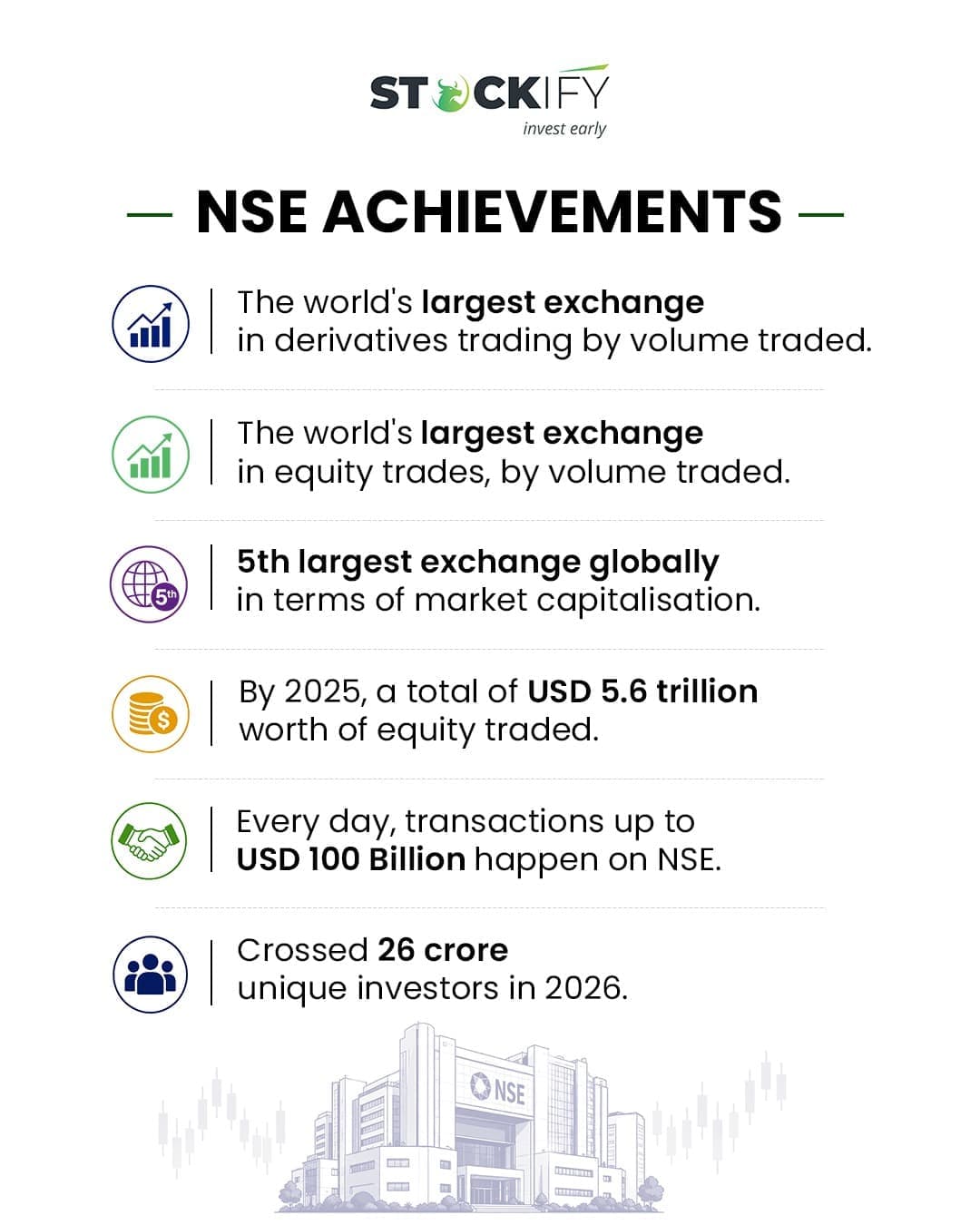
These milestones have been an important factor in driving demand for nse share price unlisted.
After the recent yearly results, which gave positive growth, the board has recommended a bonus issue of 4:1. Not just this, the exchange also recommended giving a dividend of Rs 90 per share to all its shareholders. After this announcement, the nse pre ipo price reached Rs 6,500 per share(pre-bonus) and around Rs 1900 per share (post-bonus).
Read more here: NSE Unlisted Share Dividend: 5 Year Analysis.
The financial performance of the company has improved since last year. Its revenue increased by 42.62% from Rs. 12,765.36 crores in FY24 to Rs. 16,434 crores in FY25. Annual EBITDA grew by 28% from Rs 9,870 cr. to Rs 12,647 cr. in FY25, reflecting a significant increase in NSE’s profitability. The data shows the company's positive performance compared to the previous year. This is the major reason why people look for NSE share prices.
NSE is better than the BSE (Bombay Stock Exchange) in terms of liquidity. In other words, buying or selling NSE unlisted shares is simpler than BSE shares, and you will get better opportunities to convert NSE unlisted shares to cash. The trading volume is also relatively high on the NSE, indicating ample sellers and buyers available for trading. Thus, NSE entices more investors than its rivals. Over the years, NSE financials have remained positive compared to the BSE. Based on the recent financial report, NSE has performed better than BSE. It is beneficial for investors to buy NSE unlisted shares for long-term benefits.
Read here to know more: NSE vs BSE Detailed 101 Comparison Anaylsis.
NSE Unlisted Shares can be worth buying due to growing financials and increasing investor participation. With IPO on the cards, buying Nse Pre Ipo shares can be a good investing opportunity. Let’s explore these factors in detail.
In FY25, NSE reported a total income of ₹19,177 crore, marking a 17% year-on-year increase. Operating EBITDA grew by 28% year-on-year to ₹12,647 crore, with a robust margin of 74%.
In FY25, over 84 lakh new active demat accounts were added on the NSE, a 20.5% year-on-year increase, bringing the total to 4.92 crore
The NSE has achieved a significant global milestone by ranking as the fifth-largest stock exchange worldwide.
The NSE’s unlisted shares are trading at a high price-to-earnings ratio of 44x, indicating robust financial performance and investor confidence.
The Securities and Exchange Board of India (SEBI) has cleared the final regulatory hurdles for NSE’s IPO, signalling a crucial milestone for the exchange.
Do you wish to get a higher ROI by investing in NSE Unlisted Shares? At Stockify, you will get all the assistance to make a sensible decision. You can quickly assess your requirements to buy NSE unlisted shares with inclusive research, actionable insights, and analysis. Our stock experts are always here to help you understand NSE unlisted share price overview and performance. Moreover, you will get complete assistance throughout the process.
Stockify updates pre-IPO stock prices regularly. If you plan to buy NSE unlisted shares, check the live NSE unlisted share prices on our portal. We keep monitoring the National Stock Exchange unlisted share price fluctuations and other market trends. You can check the current NSE unlisted share price here.
You can either subscribe to our daily newsletter or manually check the latest NSE unlisted share price. Login to our portal to buy NSE unlisted shares in no time.
As a retail investor, you should manage your wealth and portfolio effectively. At Stockify, we have a list of many high-performing unlisted companies in India. We allow users to choose from the best unlisted shares in India, private equities, ESOPs, and much more. Investors can choose from various industries, including tech, healthcare, fintech, retail, etc. Browse our list of unlisted companies offering their pre-IPO stocks in India.
Disclaimer: The information provided by Stockify is for educational and informational purposes only and does not constitute investment advice. Stockify is not a SEBI-registered broker, investment advisor, or research analyst. Investments in unlisted shares involve risks. Please consult your financial advisor and conduct your own due diligence before making any investment decision.