

TL;DR
NSE has filed its DRHP in June 2026, bringing its long-awaited IPO a step closer.
FY26 remained financially strong, with Rs.18,713 crore revenue, Rs.10,180 crore PAT, and a 55.4% net profit margin despite a moderation from FY25.
Its scalable business model and dominant market position could continue to support strong profitability and long-term growth.
NSE unlisted shares have delivered a 190.76% return and a 30.6% CAGR over the last five years.
_____________________
The National Stock Exchange of India (NSE) has played an integral role since 1994 after it started providing commodity exchange services. Today, NSE Nifty is one of the most preferred indices in the stock market of India. However, NSE itself is a profitable business and has unlisted shares actively traded in the grey market. Retail investors have been favouring NSE India unlisted shares as a preferred investment choice, which has been boosting the NSE share price.
What are the reasons that make NSE India unlisted shares popular in the grey market? Moreover, what is the return on investment (ROI) for NSE shares? A prediction on NSE share prices in the future shall answer these questions. However, NSE can’t perform well without the growth of the Indian stock market. Since the development and growth of the Indian market precede the growth of stock exchanges in India, let us take a closer look at the Indian stock market.
Indian Stock Market - An Extrapolation
The stock market became less favourable during the pandemic of COVID-19; however, the businesses regained their pace in the last two years. After the market opened, the companies started drawing investments again, and the public issue of stocks became more common. Moreover, the continued efforts of the Reserve Bank of India to minimise the effects of global inflation on the Indian economy have brought remarkable improvements.
As of May 2026, the Consumer Price Index (CPI), a key measure of retail inflation, stood at 3.93%, remaining within the RBI's target range. However, amid global economic uncertainties and geopolitical tensions, Foreign Portfolio Investors (FPIs) have remained net sellers, with cumulative equity outflows exceeding Rs.2.2 lakh cr so far in 2026.
India’s increasing role in global trade and the growing interest of foreign brands and businessmen in India’s market are opening more doors to a stable economy. Moreover, stock investments and broking firms remain bullish about trade. In contrast, the world has been taking a careful approach to businesses and investments owing to the adverse business environment. This sums up the path of India’s stock market in the near future.
The predictions for the distant future of the Indian share market aren’t much different either. In the long term, India’s stock market is expected to continue growing and expanding. More companies will join the pool of listed companies, more equity shares will be available for trade, and more commodities will be exchanged.
Prediction Of NSE Share Price And Return On Investment
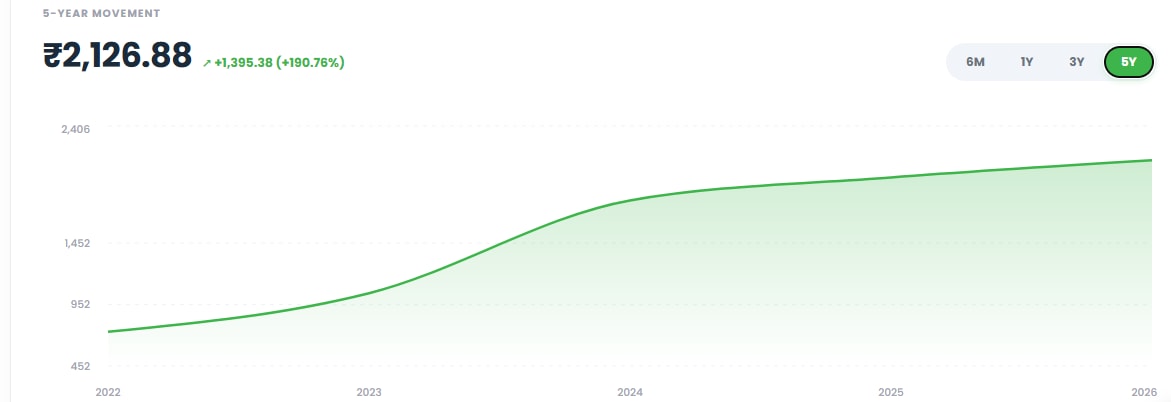
Let's understand NSE unlisted Share price movements:
Let’s start by understanding the reasons for the National Stock Exchange of India (NSE) growth.
As more retail investors and companies join the pool, stock exchanges like NSE witness a higher trade volume. This, in turn, allows NSE to generate huge revenue and increase market capitalization every year. Therefore, it isn’t surprising that NSE is a highly profitable business entity with spectacular yearly performance. The FY 2026 financial performance of NSE reflects this.
A. Revenue Remains Strong
NSE reported revenue of Rs.19,176.8 cr in FY25, up 16.7% YoY from Rs.16,433.6 cr in FY24. In FY26, revenue moderated slightly to Rs 18,713.4 cr, reflecting softer derivatives trading volumes.
B. Expenses Increased
Total expenses increased from Rs.3,169.4 cr in FY24 to Rs.4,259.7 cr in FY25, before rising further to Rs.5,376.4 cr in FY26. Despite higher operating costs, NSE maintained strong profitability owing to its scalable business model and healthy operating margins.
C. Consistently High Profitability
Despite lower revenue in FY26, NSE generated a Net Income of Rs.10,371.1 cr with an impressive 55.4% net profit margin. The company continues to maintain one of the highest profitability levels among global stock exchanges.
D. Strong Earnings Per Share (EPS)
NSE's EPS increased from Rs.33.58 in FY24 to Rs.49.24 in FY25, before moderating to Rs.41.62 in FY26. Even after the decline, earnings remain significantly higher than FY24 levels, highlighting the exchange's resilient business model.
Consolidated P&L Figures (Rs. Cr) | FY26 | FY25 | FY24 |
Revenue | 18,713.4 | 19,176.8 | 16,433.6 |
Expenses | 5,376.4 | 4,259.7 | 3,169.4 |
EBITDA | 13,337.0 | 14,917.1 | 13,264.3 |
Profit Before Tax (PBT) | 13,895.6 | 15,474.8 | 11,184.3 |
Profit After Tax (PAT) | 10,179.5 | 11,605.8 | 8,406.5 |
Net Income | 10,371.1 | 12,230.5 | 8,311.4 |
EPS | 41.62 | 49.24 | 33.58 |
EBITDA Margin | 71.3% | 77.8% | 80.7% |
Net Margin | 55.4% | 63.8% | 50.6% |
Source: NSE Website – Financial Highlights
Overall, despite a temporary slowdown in FY26, NSE continues to generate strong cash flows, industry-leading margins, and consistent profits, making it one of the strongest businesses in India's capital markets ecosystem.
The consistent revenue growth over the years and healthy profitability are answered by an increase in share price. Over the last five years, the stock has delivered an impressive 190.76% return with a strong 30.6% CAGR in the last 5 years. Therefore, NSE unlisted shares are a high-return investment option, which means they bring a high return on investment. Therefore, if you are looking for multi-bagger stocks, purchase NSE India unlisted shares on Stockify today.
The Future Of NSE India Unlisted Shares And IPO
NSE India is not listed on the stock exchange and is only traded on the off-markets. However, that hasn’t dimmed the popularity of NSE India unlisted shares, and they continue to be one of the most actively traded companies to be traded actively in the grey market. Following the filing of its Draft Red Herring Prospectus (DRHP) with SEBI in June 2026, the company's long-awaited IPO has moved a significant step closer to listing. The proposed issue is entirely an Offer for Sale (OFS), with no fresh issue of shares, and is expected to be among the largest IPOs in India's history. While the final IPO timeline and price band are yet to be announced, investor interest in NSE unlisted shares could remain strong due to the exchange's dominant market position, robust financial performance, and consistent profitability.
Experts advise investing in unlisted stocks like NSE, which bring significant returns when they become listed through an Initial Public Offering (IPO). Therefore, for high returns, track the NSE unlisted share price and invest through the Stockify platform. It is India’s most trusted platform for exchanging unlisted shares. Since stock prices are ever-changing, Stockify regularly updates the share prices of top-performing stocks and provides more information on their market performance. Browse the top-performing stocks on Stockify, and check their market indicators, like EBITDA margin, profit growth, and revenue growth, to find the right stock to buy. Or you can connect with the experts on Stockify and skip the research. These advisors are there to recommend the best stock and lot size per your requirements.
Frequently Asked Questions On NSE India Unlisted Shares
Is it good to buy NSE unlisted shares?
NSE India unlisted shares are high-performing stocks and a leading investment option. Therefore, buying NSE unlisted shares is suitable for significant returns.
What is the value of the NSE unlisted share?
An NSE unlisted share price is a changing quantity subject to market behaviour and investors’ interest. Check the NSE share price today on Stockify, where it is regularly updated.
Is it safe to buy unlisted shares?
Unlisted shares are high-risk and high-return stocks, high risk because of a lack of liquidity, and high returns as emerging companies are expected to grow.
What is the minimum investment in unlisted shares?
The unlisted shares are bought in lot sizes, which depend on the specific unlisted shares. For more information, connect with our experts on Stockify, who will recommend the appropriate lot sizes.
Will I get a dividend from unlisted shares?
Dividends are announced after the company has a highly profitable performance in a financial quarter.