1.jpg)

TL;DR
MSEI is a SEBI-recognised stock exchange offering equity, derivatives, currency, debt, primary market, and index services through a technology focused platform.
The exchange earns revenue from transaction charges, listing fees, memberships, market data, connectivity services, and treasury income, although treasury income currently contributes the majority of earnings.
MSEI has raised Rs.1,240 cr over the past two years and introduced the Liquidity Enhancement Scheme (LES), boosting daily cash market turnover from below Rs.1 cr to over Rs.350 cr on peak trading days.
Despite the turnaround, MSEI's cash equity market share remains below 1%, with NSE and BSE continuing to dominate. The exchange's long-term growth depends on increasing liquidity, broker participation, and scaling its core trading business.
________________________________________
The capital markets of India are the driving force behind the Indian financial system, whose engines are the stock exchanges, which facilitate billions of transactions daily. Even though giants such as NSE and BSE are at the forefront, the Metropolitan Stock Exchange of India Limited (MSEI) has managed to present a novel situation whereby it has become a major player due to its sophisticated platform for diverse asset classes.
As MSEI continues to establish its niche, it is supported by regulatory membership, modern technology and an aspiration to empower more market players with access to the market. The insights into the business model and the financial condition of MSEI provide useful information on how smaller exchanges seek to compete and exchange innovation in an increasingly saturated landscape.
MSEI in Indian Financial Markets
MSEI is a nationally recognised, SEBI-regulated stock exchange that provides trades in a variety of markets, including equity cash markets, equity derivatives, currency derivatives, and the debt market. It started its operations in 2008 when it launched its currency derivatives platform.
It later expanded into equity cash and derivatives trading, as well as debt market operations, in 2013. Despite having suspended its trading in the debt segment since 2020, MSEI is still licensed to operate in all these spaces, and it has the ambition to continue expanding its product offerings.
Business Model of MSEI
Besides traditional equity dealing, MSEI offers other financial instruments, including exchange-traded funds (ETFs), sovereign gold bonds, and small and medium enterprises (SMEs) for listing their shares. To assist its clients in the market, MSEI has created its own indices, such as the SX40, which covers 40 large-cap stocks in India, and the SXBANK, which specialises in the banking sector. Such indices are used as performance benchmarks, as well as derivative products and risk management products.
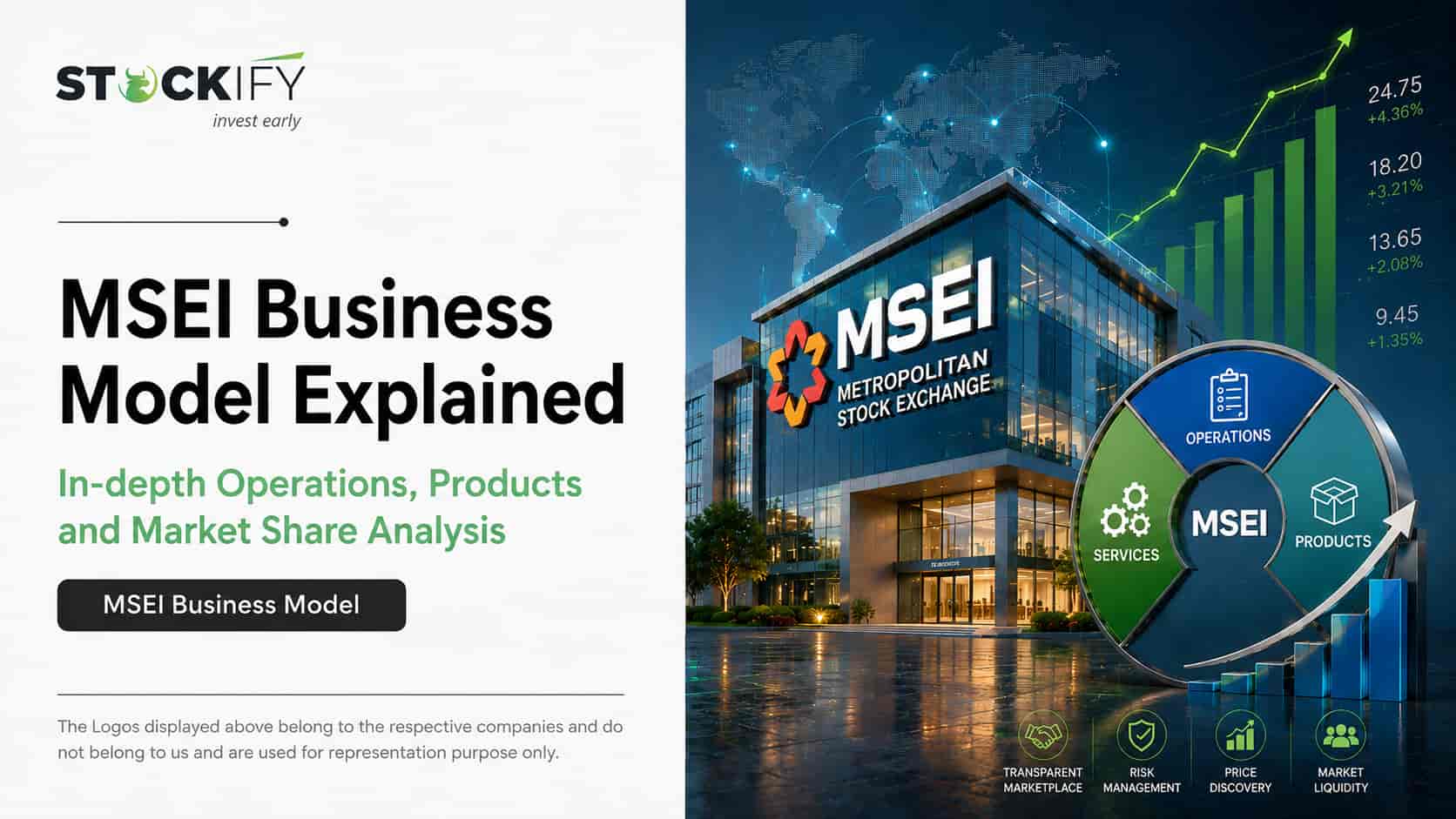
The core of MSEI's business model is its hi-tech electronic trading platform. The exchange focuses on fast, safe, and transparent trade execution with the infrastructure that places a strong focus on fault tolerance, real-time data replication, and cybersecurity functionality.
Here are some of the services given by MSEI:
1.Transaction Charges
This is the core revenue source of almost every stock exchange. Whenever a trade is executed, the exchange earns a small fee. The fee is charged across products such as
Equity
Currency derivatives
Debt securities
Other permitted instruments
However, MSEI's trading volumes remain much lower than those of NSE and BSE, which limits this revenue stream. MSEI has therefore focused on liquidity enhancement initiatives, including designated market makers, to increase trading activity
2. Listing Fees
Companies pay fees to list securities on MSEI. These include
Initial listing fees
Annual listing fees
SME listings
Debt securities
This creates recurring income because listed companies continue paying annual fees as long as they remain listed. Unlike transaction income, listing revenue depends on attracting issuers rather than trading volumes.
3. Membership Fees
Only registered trading members can access the exchange. Brokers pay for
Membership
Registration
Annual renewal
Connectivity
Trading terminals
These are relatively stable revenues and are less volatile than transaction charges.
4. Market Data Business
Every order submitted on the exchange creates valuable market data. MSEI licenses
Live market feeds
Historical data
Tick-by-tick information
Corporate action feeds
Customers include
Brokers
Financial institutions
Research firms
Fintech companies
Data vendors
Market data is generally a high-margin business because the information is generated by the exchange's own trading platform.
5. Technology & Connectivity Services
Since exchanges are technology platforms, participants pay for access to infrastructure. These services include
Trading terminals
API connectivity
Network access
Technology infrastructure
These services generate recurring income because brokers require uninterrupted connectivity to participate in the market.
6. Regulatory Market Infrastructure Services
As an exchange, MSEI also earns income by providing regulated market infrastructure, including:
Trading systems
Market surveillance
Compliance infrastructure
Corporate announcements platform
Debt issuance support
Electronic Book Provider (EBP) services
These services could support issuers and market participants while complying with SEBI regulations.
7. Treasury Income
Important observation is seen in recent financials of MSEI that other income is substantially larger than revenue from operations. In FY26, the revenue from operations was Rs 3.38 cr, while other income reported Rs 55.69 cr. Altogether, total income is Rs. 59.07 cr. This could show that a larger portion of MSEI’s income presently comes from treasury operations.
This includes interest earned on investments, bank deposits and other financial assets. Now this is the key difference from other major exchanges, where operation revenue dominates total income. This preoccupation with technology ensures that traders, customers, and banks, among other players in the market, can trade easily and without any fear.
MSEI has a wide environment, including stockbrokers, banks, corporates, depositories, custodians, and retail and institutional investors. Besides enabling trading, the exchange is also involved in promoting financial literacy and investor education in India, which is part of the heightened role of SEBI and financial inclusion. This undertaking makes MSEI not only a trading ground but also part of creating a more informed investor base in the country.
MSEI Strengths
1. SEBI-Recognized Stock Exchange
MSEI is one of a few stock exchanges in India recognized by SEBI. This could give it the regulatory approval to operate across multiple market segments.
2. Multi-asset trading platform
MSEI is different from other niche-focused exchanges, offering multiple products.
This diversification allows the exchange to earn revenue from several business lines instead of relying on a single segment.
3. Asset-Light, High Operating Leverage Business
MSEI follows an asset-light model, meaning the business is driven by technology, which is similar to other exchanges.
Once the trading infrastructure is built, additional trading volume could generate revenue with relatively low incremental costs.
4. Fresh Capital and Strategic Investors
Over the 2 years, MSEI has raised approximately Rs.1,240 cr through two capital raises to strengthen the balance sheet, technology, liquidity enhancement initiatives, a new data centre, and the development of new products.
5. Liquidity Enhancement Scheme (LES)
One of MSEI's key competitive strategies is its Liquidity Enhancement Scheme (LES), which incentivizes market makers and trading members to improve liquidity and narrow bid-ask spreads. It relaunched active equity trading in January 2026.
MSEI states it was the first national exchange to introduce such incentives in the equity cash market. This helped improve trading activity, with daily cash market turnover rising from below Rs.1 cr after the relaunch to over Rs.350 cr on peak trading days.
Also Read: MSEI Liquidity Enhancement Scheme (LES), Process And Impact
6. Large Growth Opportunity
India's capital markets could continue to expand through:
Rising retail participation
Increasing demat accounts
Higher mutual fund investments
Growing derivatives market
If MSEI captures even a small share of this expanding market, it could materially increase its operating revenues.
MSEI Challenges
Low Market Share
The exchange industry of India is mainly dominated by NSE and BSE. This is a major challenge for MSEI. Both account for nearly all equity trading, which leaves a small share of market activity for MSEI.
Liquidity trap
Stock exchanges benefit from network effects:
1. Traders prefer exchanges with high liquidity
2. High liquidity attracts more traders
More trader prefer liquidity further
This could create a difficult cycle for MSEI to break, as participants normally are attracted towards exchanges with deeper order books.
Low Operating Revenue
MSEI's recent financials show that other income (such as interest on investments) exceeds revenue from core exchange operations. This indicates that the exchange has not yet scaled its primary business of facilitating trades
Dependence on Broker Participation
An exchange cannot succeed without active participation from brokers and market makers.
Even with modern technology, MSEI must persuade brokers to route orders to its platform to build liquidity and attract investors.
MSEI Market Share Analysis
Metrics | NSE | BSE | MSEI |
Cash Equity (Spot) | 95% market share | 5% market share | Under 1% market share |
Equity Derivatives Market Share | 95% | 5% | 0% (F&O inactive) |
Currency Derivatives | Dominant (more than 95%) | Small share | Under 1% (very small) |
Available Contracts | USDINR, EURINR, GBPINR, JPYINR | USDINR, EURINR, GBPINR, JPYINR | USDINR, EURINR, GBPINR, JPYINR |
Active Cross-Currencies | EURUSD, GBPUSD, USDJPY | Terminated / Inactive | Terminated / Inactive |
Debt Market | One of the two dominant platforms | One of the two dominant platforms | Negligible |
Core Strengths | Maximum market liquidity, deep institutional backing, and a globally dominant index (Nifty 50) | Oldest exchange in Asia, massive directory of listed entities, popular index (Sensex). | Active in currency derivatives, low debt footprint, and a heavily restructured tech stack. |
Listed Companies | Above 2,200 | Above 5,600 | Nearly 140 actively traded securities
|
While comparing with NSE and BSE, MSEI majorly commands only the cash equity segment. MSEI recently resumed its trading this year in the month of Feb. Its market share remains below 1%, despite sharp improvement in trading activity followed by the launch of the Liquidity Enhancement Scheme (LES).
On 25 June 2026:
NSE Equity Turnover: Rs.12,277.6 cr (Source)
BSE Equity Turnover: Rs.11,802 cr
MSEI Equity Turnover: Rs.188.40 cr (Source: MSEI )
This converts into an approximate market share of NSE with 91-92%, BSE with 8-9% and MSEI with less than 1%. However, the more important trend could be the growth in MSEI's own activity. Before the LES, daily cash-market turnover was often below Rs 4 cr. After market makers were introduced in April 2026, turnover rose to Rs 30.36 cr on the first day and later touched Rs 357.61 cr. This could demonstrate a significant improvement in liquidity from a very low base.
Hence, MSEI might not be competing product-for-product with NSE and BSE today. So, cash equity could only segment with measurable traction, while all the other segments likely remain negligible. Altogether, instead of analysing market share across all product segments in the near term, it could likely track average daily cash turnover, active securities, and broker participation.
A significant positive development during FY25 was MSEI’s successful capital raise, which was raised by the company in the form of a private placement with investors, including Billionbrains Garage Ventures, Groww's parent, and Zerodha's Rainmatter Investments. This capital investment not only made the exchange solid regarding its capital reserves, but it also provided much-needed liquidity in terms of operations and strategic plans.
Read More here: MSEI FY26 Results: Revenue Up 240%, Operations Decline
MSEI Problems and What Lies Ahead
Although these improvements provide relief, MSEI’s volumes are very low compared to NSE and BSE. A good number of companies are yet to be willing to list on the MSEI platform, and also, the exchange is not seeing much growth in terms of gradual developments, such as mutual funds and ETFs.
However, MSEI is eyeing new opportunities, such as the establishment of block deal platforms and the successful strategies of its competitor exchanges, in a bid to restore its cash market presence. Its unlisted shares have become a site of intense interest since it is speculated that it might conduct an IPO in the future and may grow substantially in the long run.
Overall, MSEI is a multi-segment, highly technological, and SEBI-regulated platform that provides a wide range of financial products and has a user-friendly approach to investor education. Through calculated efforts and market building, MSEI still has a chance of finding a niche in the competitive Indian financial markets.
If you're exploring opportunities in India's unlisted markets or considering diversifying your investment portfolio, check out MSEI unlisted shares and other unlisted investment opportunities on Stockify to stay ahead of emerging market trends.